
Europe’s Ailing Social Model: Facts & Fairy-Tales
From the desk of Martin De Vlieghere on Thu, 2006-03-23 08:43
This article was written by Martin De Vlieghere and Paul Vreymans.
On 23 and 24 March the European Council is meeting to discuss the future of Europe’s social model. The very essence of the welfare state is at stake. Europe’s present social model is unable to tackle the modern challenges of globalization, and has left Europe with gigantic problems: an unsurmountable public debt, a rapidly ageing population, 19 million unemployed, and an overall youth unemployment rate of 18%. The unemployment figures may easily be doubled to account for hidden unemployment. The untold reality is that Europe’s real unemployment stands at the level of the 1932 Depression.
A man-made Disaster
Europe’s social disaster is unfolding while the rest of the world is booming at its fastest rate in three decades. 2004 and 2005 were record years for China and India, which have double-digit growth rates, and for the USA, which fully enjoys the benefits of globalization. The world’s economy is booming at an average rate of over 4%, but Europe’s growth has stagnated at an inflated 1.5%.
Why is Europe performing so poorly? Europe’s deficient performance is incompatible with its huge potential as the world’s largest single consumer market. Its slow growth contradicts its unequalled industrial productivity and infrastructure, its outstanding education level and labour ethics, its favourable climate, “fair business” morality, and not in the least its tremendous potential provided by the opening of the iron curtain. Obviously Europe’s fairy-tale is not materializing. Nor are the inflated expectations prognosticated by Europe’s political elite at the launch of the Common Currency and the Lisbon Agenda.
Deficit Spending & Threatening Debt Crisis
The reality of Europe’s ailing economy contrasts sharply with its economic potential and with the massive resources employed to cure its ailing growth. The whole arsenal of Keynesian remedies has now been tried and has failed one by one. Massive deficit spending throughout the eighties and nineties has left Europe with a public debt unequalled in history. The size of Europe's monumental public debt is only surpassed by the hidden liabilities accumulated in Europe’s shortsighted pay-as-you-go public pension schemes.
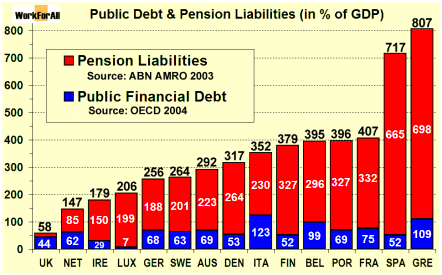
Unfunded pension liabilities now average some 285% of GDP [pdf], more than 4 times the officially published public debt figures. Total public liabilities now exceed assets in most EU countries, and are causing runaway debt service. Richard Disney calculates [pdf] that if social policies are kept unchanged, tax hikes of as much as 5 to 15 percentage points will be necessary over the next couple of decades merely to avoid the rate of indebtedness increasing any further.
Unfortunately, this will just kill growth completely. Europe’s present social model is unsustainable because it is based on robbery of future generations. Keeping the system in place would jeopardize the next generation’s future with an unbearable and uncompressible tax burden, and would seriously add to the risk of a total collapse of Europe. Moreover these expansionary social policies have not worked so far. In spite of the largest debt buildup in history Europe’s growth has remained weak anyway. Europe’s social model is built largely on credit to be paid back by its own children.
ECB Money Printing & Runaway Asset Inflation
The ECB’s expansionary monetary policy has failed as well. M3 money growth has been exceeding the real economic growth rate by an average 5% ever since the Euro was launched. Real Euro interest rates have been negative for several years now. The only obvious effect has been run-away asset inflation and an unprecedented speculative bubble. Today Europe’s bond prices have reached historical highs, and Euro-stocks’ earning ratios are at historical lows. Prices of building plots in Belgium have doubled and even tripled in some areas. In Brussels apartment prices rose by 50% over the last 12 months, driving many native Belgians out of their hometown because living in Brussels has progressively become an exclusivity affordable only for Europe’s privileged bureaucrats.
Obviously the Keynesian expansionary strategies are not working and the ECB’s money printing is only making things worse. Present policies are leading to an Argentinean-style debt crisis. The challenges of globalization and Europe’s rapidly ageing population call for an urgent fundamental policy change. The 19 million unemployed (that is the official figure, but 38 million is closer to the truth) no longer believe Europe’s “social” fairy tales and can no longer wait.
Faked Public Debate
In an effort to keep the dancing on the Titanic going, Europe’s catastrophic situation is systematically hidden from public opinion. Official unemployment data, debt figures, and poor growth performance are systematically and grossly underestimated. Thus the public debate and the whole democratic decision making process is being falsified by lies and wishful thinking. Even the best policy makers are making the wrong diagnosis based on the wrong statistics, and as a consequence prescribe the wrong remedies. Having accumulated such monumental debt through years of over-consumption, Europe can indeed no longer blame its ailing growth on slow consumer sales. It is the supply side that is failing. Policies aimed at boosting Europe's economy should therefore no longer be aimed at stimulating consumption but at stimulating the defaulting creation of wealth.
Bureaucracy & A Crippling Tax Burden
Europe’s production is failing because of bureaucracy and a paralytic tax burden. The reality on Europe’s work floor is that the workforce is demotivated, and that Europe’s personnel and managers are increasingly rebelling against the persistent confiscation of over 50% of the fruit of their labour. The excessive tax burden leaves Europe’s workforce too little to lead the standard of living they earn. Businesses are deprived of the resources needed to finance their innovative projects and to compete in the global markets, if foreign entities have not yet bought their assets.
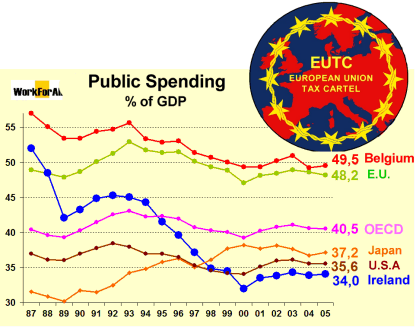
Europe’s well-intentioned model is not working because it does not pay to work after the taxman has taken his share. Europe is not innovating because it does not pay to innovate after the huge costs of complying with all the prescriptions, limitations and restrictions in all Europe's overabundant licences and autorisations. Demoralization is the real cause of Europe’s stagnation. Europe’s workforce is tired of being incessantly hindered in its task of producing wealth. Demoralization is the reasen why ever more engineers, scientists and entrepreneurs flee Europe’s tax misery. Paradoxically, the Old Europe of the West must now learn from the New Europe of the East, where after years of disastrous socialism, low and simple flat taxes are being introduced, luring investors from all over the world.
Scientific Evidence
In his research into the causes of growth differences between OECD economies the American economist James Gwartney irrefutably demonstrated [pdf] the direct relation between tax burden and economic growth. The higher the level of taxation, the lower the growth rate. The explanation is as logical as it is simple. The higher the tax level, the lower the incentives to make productive contributions to society. The higher the fiscal burden, the more resources flow from the productive sector to the ever more inefficient government apparatus.

Gwartney’s findings provide the final explanation why continental European economies, such as Belgium, no longer grow. The Belgian tax burden is 20% above the optimal tax level burden as calculated by Primo Pevcin [pdf]. It is 9 %-points above the OECD average and 15 %-points higher than the tax level in the US and Japan.
WorkForAll’s empirical study analyzing 25 plausible causes of economic growth in a comprehensive regression arrives at the same conclusions. The best way to spur growth is by reducing the tax burden and Europe’s languishing government sector, and by shifting taxes from income to consumption.
Adapting Europe’s Tax Structure for Globalization
With an excess proportion of direct taxes, Europe’s tax structure is totally unadapted to globalization. Direct taxes on profits, wages and capital increase the cost of domestic production, and in doing so have exactly the opposite effect of import duties. Direct taxes roughly double the cost of Europe’s domestic production, making Europe’s produce uncompetitive both in the home market and in global markets. Just as import duties cause protectionist distortions in world trade, direct taxes do the same, but in the absurd opposite sense. Globalisation therefore necessitates more urgently than ever a shift of the tax burden from production to consumption.
It is, indeed, a direct result of the trade distortions caused by direct taxation that is causing Western Europe to losing ever more rapidly its semi labour-intensive sectors to countries where productivity is lower than in Western Europe. This relocation from countries with high productivity to low productivity countries is a pure waste. It is not only disastrous for Western Europe’s employment. It is also harming worldwide development as Europe’s highly productive production apparatus and infrastructure are left idle. With Europe’s potential not being used to capacity, the direct-tax distortions are leading to less than optimal global labour division and wealth creation.
The success-story of the Irish alternative
Europe will only be able to maintain its prosperity and generous social system if it succeeds in generating a growth rate of 4 to 5% over the next couple of decades. This is not impossible. Ireland has shown us how to do it. The Irish economy has been booming at an annual growth rate of over 5.6% for over 20 years now. In barely 18 years Ireland has made the unbelievable jump from the 22nd to the 4th place in the OECD prosperity ranking.

Ireland thanks its success to its clear-cut different tax policy. With 33%, the Irish overall tax burden is the most moderate of Europe. Ireland also has a unique fair-flat-tax structure, which fairly and evenly spreads the weight of the tax burden over profits, labour and consumption. This unique tax structure is the key to Ireland’s success. Contrary to the rest of Europe’s demoralizing tax structure, the Irish tax model provides a positive stimulus to participation, saving, investment and enterprise: the crucial factors which the rest of Europe lacks.
For 20 years now, the Irish social model has proven its effectiveness not only in creating wealth and jobs, but also in providing Irish authorities with ample resources for their wide range of cultural, environmental and social initiatives, as well as for the costs of ageing. The unequalled Irish success story proves that their alternative policies are reliable and realistically feasible within the current European framework.
Scandinavian Myths
Despite the overwhelming success of the Irish alternative, adepts of large state interference continue to plead in favor of a Scandinavian model. Nonetheless the outdated Scandinavian policies have proved to be particularly inefficient. The Scandinavian countries have gone through a long period of steady decline with poor growth and job creation. In 1970, Sweden’s level of prosperity was one quarter above Belgium’s. By 2003 Sweden had fallen to 14th place from 5th in the prosperity index, two places behind Belgium. According to OECD figures, Denmark was the 3rd most prosperous economy in the world in 1970, immediately after Switzerland and the United States. In 2003, Denmark was 7th. Finland did badly as well. From 1989 to 2003, while Ireland rose from 21st to 4th place, Finland fell from 9th to 15th place.

Together with Italy, the Scandinavian countries are the worst performing economies in the entire European Union. Rather than taking them as an example, Europe’s politicians should shun the Scandinavian big-government recipes. If there is anything to be learnt from the Scandinavian experience it is that Scandinavia succeeds in making a more efficient use of public resources, through investment and innovation. Nevertheless even their most restrictive unemployment policies will never result in higher growth so long as they keep their Keynesian policies and excessive government in place. The best proof of the failure of the Scandinavian model may be that the Scandinavian countries themselves are increaslingly abandoning it.
EU Tax Harmonization
Europe’s many high-tax and very-high-tax regimes view Ireland’s success with envy. They fear that less greedy and more efficient governments will develop Irish style reconstruction initiatives. Such a trend could lead to “tax competition” which would force them to improve their own public efficiency. In contradiction of all EU-Treaties guaranteeing full autonomy in fiscal affairs to the member-states, Europe’s high-tax regimes are now trying to prevent Irish-type reconstruction initiatives from developing in other countries. Fearing competition from less greedy and more efficient governments they are trying to impose their high-tax-regimes on other EU-members through a new directive.
In the same sneaky way as the EU’s devastating savings directive was introduced, a tax-base harmonization scheme is now being proposed, obviously as a first step toward imposing a back-door harmonization for corporate tax rates also. Despite the severity of Europe’s high-tax disaster Europe’s high-tax-regimes obviously still refuse to see the unsustainability of their high-spending high-debt high-tax policies. These Keynesian policies have failed.
Curing the symptoms no longer helps. It is time to tackle the real and ultimate cause of Europe’s stagnation, namely the total discouragement of Europe’s work force. It is time to free Europe from its bureaucracy and its crippling tax burden. Failing this Europe will continue to lag behind ever further and its current relative impoverishment will soon turn into absolute pauperization, ultimately resulting not only in economic, but also in cultural and moral decline. If the economy is sick, it is because democracy is ill as well.
Domestic debt is **GIGANTIC **.
Submitted by Paul Vreymans on Wed, 2006-04-05 15:34.
The Copenhagen Post's title "The Debt is gone" is misleading because Denmark still has a huge domestic debt of some 314%GDP. This slogan gives the wrong impression of comfort to hasty title-readers, and help to keep the dancing on the Titanic going.
Furthermore Danish welfare reform goes in the wrong direction by focussing too much on diminishing the counter of the fracture Debt/GDP, and for the purpose of the matter will have to reduce social expenditures either by lowering social benefits or by progressively hardening eligibility rules to those benefits. These policies will have deflationary effects and cannot but affect growth negatively. Moreover at the pace Danes started it will take over 138 years to pay back the 314%GDP liabilities.
Irish Policies on the other hand are dynamic and reduce debt by focussing on increasing the denominator of the fracture public Debt/GDP. Irish policies are conceived at boosting the economy (GDP) through tax cuts, giving prospects to their citizens; boosting morale and entrepreneurship. The historical and scientific evidence in favour of such policy is overwhelming. Such production-stimulating policies have simply worked everywhere where they were applied. That was the case in the U.S. under Reagan, that the case in Iceland under Oddson, this is the case in Ireland now, and even German's "Wirtschaftswunder" under Erhard was a model of production stimulating policy characterized by robust tax cuts. One is blinded by ideology if one denies the 20 YEARS of overwhelming Irish success and relative Danish decline.
.
Read the ideas of thinkers from across the EU on the matter on their book " BEYOND THE EUROPEAN SOCIAL MODEL "
Or read WorkForAll's empirical research into the causes of Growth differentials here.
Think tank's lack of knowledge is**TITANTIC **.
Submitted by Gorm on Wed, 2006-04-05 19:10.
The real demagogs here are this so-called "think tank" and the editor of this site.
While the storm of the globalization rages over Europe, old Europe is seeking shelter behind “economic patriotism” while the Scandinavian countries are erecting thousands of wind turbines.
The old, brutal and primitive liberalism this so-called think tank is promoting with its obsolete data will be the downfall of it and its proselytes.
Taxation is the cost of civilisation.
Gorm
Big Government is unsustainable
Submitted by Paul Vreymans on Wed, 2006-04-05 21:33.
Gorm thinks taxation is the cost of civilisation.
However history has proven this for sure: Excessive Taxation is the end of it.
See the historic evidence of Bruce Bartlett's story: HOW EXCESSIVE GOVERNMENT KILLED ANCIENT ROME
...or this economic evidence from PRIMOž PEVCIN's empiric research: DOES THE OPTIMAL SIZE OF GOVERNMENT EXIST ?
Paul Vreymans
Denmark retains its leading position
Submitted by Gorm on Thu, 2006-04-06 11:40.
The Economist Intelligence Unit on business environment rankings:
So how will you explain this Poul Vreymans? Taxation doesn’t seem to be a problem and I’m tempted to say, rather the reverse.
"Denmark retains its leading position, with a comfortable margin, despite the impact and appreciable risks associated with the country's involvement in the recent cartoon controversy with the Islamic world. The country stands out for the successful balance that it appears to have struck between the state and market. Product markets operate efficiently and labour markets are flexible (with low non-wage labour costs and few restrictions on hiring and firing). Denmark's top rank appears to belie the claim that globalisation is forcing countries to engage in a "race to the bottom" by slashing taxes. Companies' investment decisions are motivated by more than tax differentials. Furthermore, Denmark compensates for its high tax burden with the quality of its public goods, notably infrastructure and higher education."
Your problem seems to be that you want to apply your orthodox, fundamentalistic economic theories and knowledge on the Scandinavian countries – this won’t work.
And how will you explain this?
All the heavily taxed Scandinavian countries in top 10???
Growth Competitiveness Index rankings
Country Rankings 2005-2006
1. Finland
2. USA
3. Sweden
4. Denmark
5. Taiwan
6. Singapore
7. Iceland
8. Switzerland
9.Norway
10.Australia
11.Netherlands
12.Japan
13.United Kingdom
14.Canada
15.Germany
16. New Zealand
Cheers
Gorm
What is wrong with those Competitivenes indexes?
Submitted by Paul Vreymans on Thu, 2006-04-06 22:24.
Since 1984 Danmark has the lowest growth of the EU 15. Much lower than Ireland, Luxemburg, Greece and Spain. Look at this graph
Still Danmark ranks high on the competitiveness indexes of both The Economist Intelligence Unit and the World Economic Forum. Fast growing countries like Ireland, Luxemburg, Greece and Spain and even China (rank41!!!) rank low on the competitiveness indexes and drop fast on these rankings.
What is wrong with these rankings? In the case of the 'Global Competitiveness Report' we found the problem. Long ago they defined 'competitiveness' on basis of a set of criteria such as penetration rate of broadband internet, number of mobile phones, patents per capita, etc. These indexes based on 70 to 90 criteria are surely measuring SOMETHING, but it definately is NOT COMPETITIVENESS they ar measuring. How else could one explain that countries ranked high on the index perform weak in terms of wealth and jobs? But they cannot change the definition since then their annual report would loose its frame of reference.
After all, a potential invester in Denmark is not interested in how many mobiles the kids have, nor how how Danes percieve the efficiency of their government (another of the criteria), but wether their investment will yield reasonable return. The prime factors determining profitability are productivity and taxes. Denmark performs weak in both factors. Look at this graph
Poor productivity and high taxes deter investors, and without those investors there will be no sustainable economic growth and jobs. The Scandinavian countries are still performing badly - almost as bad as Belgium.
Therefor Danmark nor Scandinavia are not likely candidates as a model for the future of Europe.
Economic Outlook for Scandinavia
Submitted by Gorm on Thu, 2006-04-06 23:29.
Just a short answer for now
I think your data are a bit obsulete Paul
Economic Outlook
I'm looking forward to Nordea's May issue of economic outlook where we'll know the real figures from year 2005.
According to this article Dansk vækst er i topform it claims the Danish growth for 2005 was 3,6 %
Cheers
Gorm
Economic Outlook February 2006
Submitted by Gorm on Fri, 2006-04-07 16:04.
Economic Outlook February 2006
Danish labour model may help EU
Submitted by Gorm on Mon, 2006-03-27 18:27.
Hi Neanderthal75,
A short answer - take a look at the link below
Danish labour model may help EU
Cheers
Gorm
A better EU would mean a better world
Submitted by JimMtnViewCaUSA on Thu, 2006-03-23 16:43.
I have a number of "EU refugee" co-workers at my job in the US. They are obviously bright and talented. It is a shame that the abilities of smart people in Europe are allowed to atrophy, that energy efficient manufacturing in Europe stands idle and so on. Please put these resources to use! For the good of the wider world!
In the format of an article it is not possible to expand on all elements of the argument. And this article is certainly lengthy and full of interesting details. Still, for people who do not read daily Euro newspapers, getting more detail/documentation behind the assertion of manipulation of the news would be useful. ("Europe’s catastrophic situation is systematically hidden from public opinion.").
Certainly we see that in the US, with left publications frequently forced to admit to glaring mistakes, always mistakes which benefit one side of the debate.
Global Information Technology Report 2005-2006
Submitted by Gorm on Tue, 2006-03-28 15:28.
Interview on the Global Information Technology Report 2005-2006
1. US
2. Singapore
3. Denmark
4. Iceland
5. Finland
6. Canada
7. Taiwan
8. Sweden
9. Switzerland
10. UK
11. Hong Kong
12. Netherlands
13. Norway
14. Korea
15. Australia
Country Rankings
Huh – France at the twenty-second place?
Poor President Jacques Chirac – another assault on his narcissistic self-image and French pride.
Gorm