
The Retreat of the Western World Order

Samuel P. Huntington’s “The Clash of Civilizations” thesis has generated a lot of debate, and some justified criticism. He has been accused of simplification, but also for underestimating the case of Islam. Huntington does talk about “the bloody borders” of the Islamic world. However, he has also stated that there is nothing implicit in Islamic teachings that has created the current turmoil among Muslims, but rather the huge number of young men, the primary instigators of violence in any culture. This is obviously not the case. If Huntington had read books such as “The Legacy of Jihad” by Andrew Bostom or “Onward Muslim Soldiers” by Robert Spencer, he would have understood that Jihad and aggressive violence have been intimately related to Islam on three continents for 1300 years. Yes, an abundance of young men as “cannon fodder” for war or demographic Jihad certainly helps, but this situation was created by the contents of Islamic core texts.
The B Vocabulary of the EUSSR

He who controls the way people talk controls the way they think. Hence, it is no surprise that the EUSSR is actively trying to manipulate our language. Last February, The Daily Telegraph reported that Franco Frattini, the EU Commissioner for Justice, Freedom, and Security, declared he was in favour of some kind of self-regulatory media code in reporting about Islam. Now the EU officials are “discreetly reviewing the language it uses to describe terrorists who claim to act in the name of Islam. EU officials are working on what they call a ‘lexicon’ for public communication on terrorism and Islam, designed to make clear that there is nothing in the religion to justify outrages like the Sept. 11 attacks or the bombings of Madrid and London. The lexicon would set down guidelines for EU officials and politicians.

The Strange Transformation of Marxism

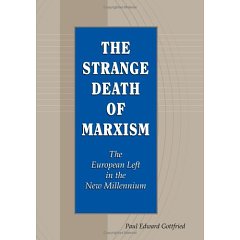
death-of-marxism.jpg

Below is my review of Paul Gottfried’s The Strange Death of Marxism: The European Left in the New Millennium. The review can be found in the April 2006 issue of Chronicles.


I have one major problem with Paul Gottfried’s latest book The Strange Death of Marxism: The European Left in the New Millennium and that is its title, which does not really fit the book. Prof. Gottfried describes how Marxism as an economic theory has lost its appeal, even among the Left, since the Second World War. Today’s leftists no longer advocate nationalization of the economy and anti-capitalist theories. In fact, they hardly care about economics at all, but focus on changing the moral and cultural foundations of Western society. This shift, Gottfried points out, originated with the so-called Frankfurt School, a group of originally German Marxist philosophers who settled in the United States in the 1930s, where they came to dominate liberal thinking, not so much by advocating anti-capitalist economic reform but rather by propagating social engineering.

The Euro Really Is In Trouble

For the first time, an official French report has criticised the Euro. The latest report of the Council for Economic Analysis (CAE) given to the French government on 23 March, “Economic policy and Growth in Europe,” written by Philippe Aghion, Élie Cohen and Jean Pisani-Ferry, draws up a really tough assessment on the single currency and the actions of the Euro zone. This evolution of official speech – at least of speech officially published – regarding to Euro is important.

Constitutional Delusion

A short round up of this week’s banalities and delusions from our leaders:

European commission president José Manuel Barroso warned yesterday against member states trying to revive the EU constitution before other European problems are solved. He rejected what he called “floating ideas” on how to revive the constitution. “It is premature to deal with the institutions, while there is no clear consensus on where to go. We should have a policy-driven agenda, so people can see the benefits of the European Union.” He underlined the need for a common energy policy and a strong internal market.

EU Fights Corruption Abroad But Not At Home

The European Parliament has called for a blacklist of corrupt governments to be drawn up so that EU development aid is not directed to crooked pockets, writes EUobserver. Last week MEPs voted in favour of a report by the Dutch socialist MEP Margrietus Van den Berg which “called for more transparent and effective EU aid and for rules that would keep banks from lending to nations that make it onto the blacklist.”

France Beyond Remedy: Sarkozy a Worthy Dauphin of Chirac

France is beyond remedy. The country is heading for collapse, and its fate will be well deserved. As expected the French trade unions and the rioting leftwing vandals (aka “students”) in the streets won the fight for political supremacy over parliament and the government. Yesterday the French president Jack Chirac withdrew the French youth labour bill (CPE), approved earlier by a parliamentary majority, while the man he stabbed in the back by doing so, Chirac’s former dauphin and France’s Prime Minister Dominique de Villepin, announced that he will not stand for the presidential elections next year.

Daisy Democracy in Italy: Prodi Yes, Prodi No…

Yesterday I wrote my brief comment on the Italian elections on the basis of first projections for the electoral results. It looked then as if Silvio Berlusconi’s right-wing coalition had lost while Romano Prodi’s left-wing coalition, the Unione, had not won; today I would say that Berlusconi has almost won. The recovery of the center-right coalition goes well beyond what anyone expected. The main reason is Berlusconi’s ability to fight the electoral campaign on the issue of fiscal policy.

The European Novel of Discontent

There is an interesting trend in Europe. Books with a similar theme are becoming bestsellers. They relate the story of a white-collar middle-class man employed in a small enterprise, who tries to make ends meet for his family. He commutes daily to a city. Confronted with the perennial transportation problem in his country he loses his temper. After crying out his rage against the collapsing civil service, harsh taxation that increasingly makes it impossible to make ends meet, the privileged corporations, and the entrenched political elites his message strikes a chord with the media looking for some drama in the somnambulist politics. Forming a new political party, he manages to capture the mood of discontent in the middle class and the book ends when he wins an election and stands poised to make some gargantuan societal change like decreasing taxation.

Syndicate content