
Lessons to Be Learned: How to Criticize the Prophet

For the upcoming breed of Muslim politicians in Europe, the cartoon crisis has been a golden opportunity in terms of public relations. They suddenly found themselves courted by journalists eager to find the “voice of moderate Islam” or, alternatively, fishing for a sensational quote encapsulating Islamic extremism in some novel way. In my own country, Belgium, one of the Muslim politicians capably giving voice to the “moderate” position is Turkish-born Ergün Top, a lawyer, town councillor in Antwerp and one of the coming men in the Flemish Christian-Democratic Party. His future is bright, for his party badly needs its handful of Muslim candidates to counter the large Muslim presence in the Socialist Party in the contest for the fast-growing Muslim electorate.
Cartoon Affair: Some Light in the Darkness

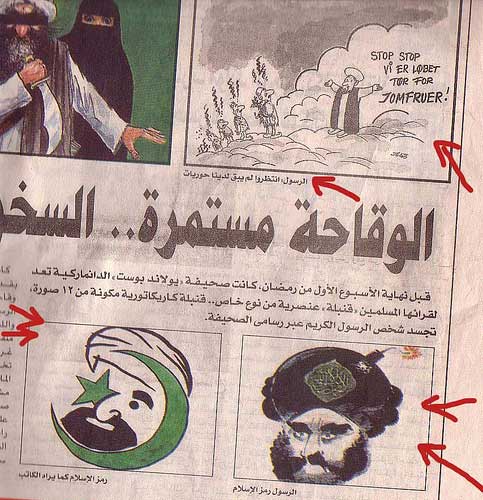
Walid al-Kubaisi, a Muslim writer living in Norway, appeals to the Western media to run the twelve Muhammad cartoons published last September in the Danish newspaper Jyllands-Posten. Mr al-Kubaisi said in a Norwegian newspaper yesterday that although he thought it was madness of Jyllands-Posten and of the Norwegian paper Magazinet, which republished the cartoons last month, to have published them, he would definitely publish them today if he were a newspaper editor. Mr al-Kubaisi explained that Islamists fanatics are currently trying to limit freedom of expression in the West. Consequently editors have an obligation to stand up to them and publish the cartoons.

The Other Culture War: EU Brings Down Slovak Government

The government of Slovakia has fallen after criticism by a European Union committee that it protects Catholic doctors against being forced to perform abortions. Two clashes of civilization are currently taking place in Europe. Freedom-loving people having to fight on two fronts. One involves the radical segment of the immigrant Muslim population that opposes basic Western values such as freedom of speech and that is intent on imposing Islamic taboos (such as the mere fact of depicting their prophet Muhammad) on the non-Islamic population. The other involves radical secularists that want to eradicate all remnants of traditional Christian culture from post-Christian Europe by restricting the right to conscientious objection on the part of religious people.

Finnish Island Wants to Leave EU

The small semi-autonomous Finnish island Åland wants to secede from the European Union. The reason is too much interference from Brussels. The specific aim of the independent Swedish-speaking island is to be allowed to present its case on the tax-free sale of snuff (or snus, a type of smokeless tobacco) before the European Court of Justice.

On Morality, Hate Crimes and War Mongering

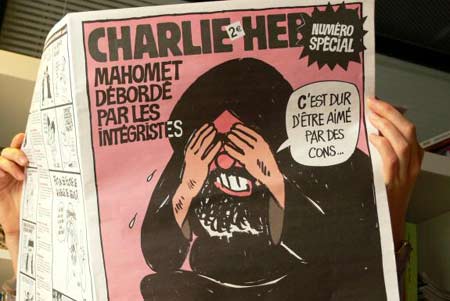
The French satirical weekly Charlie Hebdo (CH) has a picture of Muhammad on today’s front page. The prophet is crying because, he says, “it is hard being loved by idiots.” Muslim groups in France tried to prevent the distribution of CH by court order, but the court turned down the request because the complaining party failed to name Philippe Val, CH’s publisher. Mr Val, who says that he wants to defend the right to satire and sarcasm, has been put under police protection, as have CH’s offices and its editors.

charlie-hebdo-small.jpg

CH’s stunt is definitely a provocation and an insult to Muslims. CH is not a very nice paper and has a reputation for provocation (as had Theo van Gogh). In Western tradition, however, there is a difference between morality and law, as the Italian Catholic politician Rocco Buttiglione unsuccessfully tried to explain to the European Parliament on October 5, 2004, shortly before it vetoed him as European Commissioner for Justice because he considered homosexuality to be immoral (though not illegal). It is strange that neither CH nor the Muslims threathening them seem to realize this.

Dispatch from the Eurabian Front: The End of Carnival

The largest and most famous carnival celebration in Belgium is the one of the Flemish town of Aalst, 35 kms to the west of Brussels. Several groups parade through town in a pageant with floats, bands, and jesters, making fun of recent national and international events. The tradition goes back centuries, to mediaeval times. With carnival [mardi gras, as they say in Louisiana] approaching (28 February), the authorities are afraid that some groups might use the Danish cartoon crisis to dress up – God, or rather Allah, forbid – as the prophet Muhammad.

Send for the Sheriff

Last week, a group of people marched through London calling for those they disagreed with to be “beheaded”, “massacred” and “annihilated”. A pretty clear case, you’d have thought, of incitement. After all, such talk can no longer be dismissed as empty swanking. In the past five years, we have seen British boys leaving Tipton and Wanstead and Beeston to fight and kill their fellow subjects, whether in Afghanistan, Gaza or London. When the marchers dressed as suicide bombers, and called for “a real holocaust” (with the horrible insinuation that Hitler’s genocide hadn’t been real), they were not acting out a harmless fantasy. They were encouraging murder. And, sure enough, the police did detain two people for breaching the peace – not Islamist protestors, you understand, but two counter-demonstrators who were thought likely to upset the marchers.

Beware of the Russian Bear

This article was witten by Mart Helme, Estonia’s former ambassador to Moscow (1995-1999).

In the last issue of Foreign Affairs, Sarah E. Mendelson and Theodore P. Gerber report findings that, surprisingly, the attitudes amongst the youth of Russia (aged 16 to 29) towards Jossif Vissarionovich Stalin are unbelievably positive. No fewer than 51% of them regard Stalin as a wise leader, 56% thinks that he did more good than evil, and only 46% say they would not give Stalin their vote in presidential elections.

Syndicate content