
The Europe Europe Needs

Unintended, most of my articles posted here and elsewhere appear at first sight to be “anti-European.” A reader put his impression this way “what are you doing in Europe”? As in many other cases, the substance hiding below the surface differs from what meets the eye. In actual fact the writer is committed to the defense of what college courses used to call “Western Civilization.” To help you find your bearings: that was during the Ice Age. Before faculties committed to appreciating non-western civilizations felt compelled to attack our culture’s core. Ultimately they managed to eliminate the courses and turned the term into a dirty word.
Dispatch from the Eurabian Front

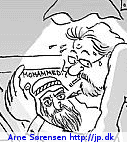
When the Danish newspaper Jyllands-Posten published a series of twelve Muhammad cartoons [see them here] on September 30 the editors probably never imagined that ten weeks later Kashmir would come to a standstill because of them. Yet that is what happened yesterday. On Thursday Kashmir, a Muslim province of India, went on strike to protest the Danish newspaper publishing the cartoons. According to Islam it is blasphemy to depict the prophet.

The strike was called by a separatist group, but was supported by the Kashmir bar association and other organisations. The authorities made elaborate security arrangements to maintain law and order. Shops were closed to express anger over the caricatures of the prophet. In some places there were clashes, and people threw rocks. “Most Muslims feel deeply affronted,” said Abdur Rasheed, editor-in-chief of the newspaper Kashmir Observer.

Tory Turmoil in the European Parliament

It has taken me a while to get this little piece together, so please bear with me. The history of the British Conservative Party and the centrist German led European People’s Party/European Democrats is long and somewhat tortuous. Suffice to say that the current deal between the Tories and the EPP was hammered out in 1999 by William Hague in Malaga, then further hammered at regular intervals since and currently the links are as thin, though less precious than beaten gold.

Last Tuesday, while Tory Member of the European Parliament (MEP) Daniel Hannan was launching his Congress of Brussels, David Cameron was elected leader of the Tories in the UK and Timothy Kirkhope was elected leader of the Tory MEPs in Brussels. Since then there have been all sorts of carry on.

Keeping Islam Pure in Europe

Every day the front pages of the European mainstream media (MSM) report ad nauseam about the alleged threat that the CIA poses to Europe. Not a single European, however, – unless they are terrorists, radical Muslims or the extremist Left – is worried about the CIA. The MSM are creating their own hype, endlessly parroting each other, and creating “consensus outrage” about a non-issue.

What really worries Europeans is illustrated in this article with contributions from Paul Belien on the situation in Flanders, Edwin Jacobs on the Netherlands and Hjörtur Gudmundsson on Denmark. It is the explicit refusal of some who have settled in Europe to assimilate into European society.

Europe Mired in Kyoto Deadlock

By its fruits you will know the tree of Kyoto. Once you know it, you will be able to make an informed, rational decision whether to pursue a post-2012 “son of Kyoto” or alternative strategies to address the ages-old challenge of climate change.

The main supporter of the 1997 climate treaty is the European Union. Despite the official, optimistic stand on its ability to meet reduction targets, the EU’s own figures show it is not likely to comply with Kyoto. According to the European Environmental Agency, in 2003 (the last year for which data are available) the EU-15 emissions were 1.7% below the 1990 levels. This is well above a hypothetical linear target path for steadily reducing emissions to the promised point. Worse, emissions aren’t decreasing, but since 2000 are on the rise.

Denmark Tackles Third World Immigration

The Danish government intends to significantly curb the flow of immigrants from third-world countries next year. The reason for this decision is a new official report on the Danish welfare system which was made public today (December 7). According to Claus Hjort Frederiksen, the Minister for Employment, immigrants from countries such as Somalia, Iran, Iraq and Lebanon are a huge burden on Danish welfare (a similar study was produced in Norway last September). Frederiksen said that immigrants allowed into the country had to have a job waiting for them.

“We are simply forced to adopt a new policy on immigration. The calculations of the welfare committee are terrifying and show how unsuccessful the integration of immigrants has been up to now,” said Frederiksen. The committee calculated among other things what it would mean if immigration to Denmark from third-world countries would be blocked completely. The conclusion was that 75% of the cuts needed in the welfare system in the next decades would disappear.

UN to Investigate Racism of Danish Cartoonists

jyllandsposten.gif

Fjordman, the Norwegian blogger (how sorely his invaluable reports from Scandinavia will be missed when he quits blogging next week) reports that Louise Arbour, the United Nations High Commissioner for Human Rights, has expressed her concern over the 12 cartoons [see them here] depicting the prophet Muhammad which were published in the Danish newspaper Jyllands-Posten last September. Ms Arbour says that the UN experts on racism will deal with the matter.

The 56 member countries of the Organization of the Islamic Conference (OIC) are currently meeting in Mecca to discuss joint action against Denmark because the Danish government has refused to call Jyllands-Posten to account and restrict the freedom of the Danish press. According to Muslims it is blasphemy to depict the prophet and the paper should apologize for having done so. Eleven Muslim ambassadors to Copenhagen had asked the Danish Prime Minister to ensure that such an apology would be forthcoming.

Could the Eurozone Rise Like Japan?

The Imperial Japanese Navy made its attack on Pearl Harbor on the morning of December 7, 1941. The number of US servicemen killed on this one day 64 years ago: 2,403. Number of civilians killed on this one day 64 years ago: 68.

On a day when Japan will deservedly be kicked around a bit, the New York Times has some good news for our brothers and sisters in the Far East:

Could it be that Japan, long the sick man among major global economies, has finally recovered? [...] [T]his time, most economists and analysts agree, the recovery seems to be real, its roots extending through the Japanese economy. After more than a decade of working off excessive debt, bloated payrolls and overbuilt factory capacity, Japan seems to have addressed its bubble-era problems and emerged leaner and more competitive, the economists say. In fact, the economy here is projected to be growing at a faster rate than Europe’s this year.

The Congress of Brussels

Czech President Vaclav Klaus and British Member of the European Parliament Daniel Hannan are about to revamp Europe. Unlike Belgian Prime Minister Guy Verhofstadt they want to do so by putting forward a democratic alternative to the European Union which corrects the wrong principle on which the EU, with its concept of the “ever-closer union,” has been built.

congress-of-brussels-2.jpg

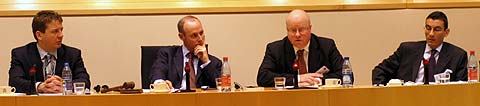
Daniel Hannan (second from the left) flanked by speakers during the Brussels Congress

Today and yesterday, 70 people from 28 countries (including Canada and the US) gathered in a conference room of the Paul Henri Spaak building of the European Parliament in Brussels. They were invited by Daniel Hannan, an MEP and a regular Brussels Journal contributor, for the first meeting of the “Congress of Brussels.”

Out of the Slough of Happiness

Slough (meaning muddy field), England, is not a lovely place. It is west of London, a bit beyond Heathrow Airport – a glum commuter town. The BBC, in a made-for-television social experiment, “Making Slough Happy,” is trying to make Slough a happier place by giving the town group therapy, bizarre as that may seem.

I am all for happiness (mine and others), but this experiment prompts a number of questions. Do we know what happiness is and can we measure it? Is it proper for a government institution (the BBC, in this case) to spend money coerced from one taxpayer (which may make him or her unhappy) to make another citizen “happy”?

Syndicate content