
Europe's Broken Promise: Reducing Red Tape

In March 2000, EU heads of state and government agreed at their summit meeting in Lisbon to make the EU “the most competitive and dynamic knowledge-based economy in the world, capable of sustainable economic growth with more and better jobs and greater social cohesion.” One of the main issues for the realisation of the so-called Lisbon Agenda was the “reduction of red tape to promote entrepreneurship.”

Despite this agreement, EU rules and regulations make up an increasing share of the overall administrative burden. A recent study by the Danish government shows that the regulatory burden for Danish companies is close to 4.1 billion Danish Kroner (550 million Euros) and that 40% of this burden is due to EU rules and regulations. And this is only with regard to the Department of Labor.

Merkel's Not So Grand Coalition

On November 22, Angela Merkel is going to become Germany’s first woman Chancellor. It is unlikely that her rule will last long and that her politics will be anything but murky. This is not her fault, but that of the German voters. The results of the September 18 general elections left Merkel’s Christian-Democrat CDU and its Bavarian sister party CSU no choice but to form a so-called “Grand Coalition” with its rival, the Socialist SPD, the second largest party of the country. Merkel would rather have governed with the smaller free-market Liberal FDP.

Germany is Europe’s biggest economy. If Germany goes well, Europe goes well. Unfortunately, today Germany is the sick man of Europe. It is being dragged down by a public deficit caused by 15 years of throwing government subsidies at the former communist East Germany in an effort to raise the East to the standards of the West. The new government has to slash an unemployment rate of 11% (4.5 million jobless, mainly in the East) and find at least €35 billion to stem the public deficit. The €35 billion shortfall is predicted on tax revenues if the economy grows at 1.8%, though experts warn it might be higher if growth be only about 1%.

Mosque Attack in France

It is becoming difficult to give you news about the situation in France. Apart from a minor incident involving a mosque, the media have lost interest or are complying with censorship recommendations from their editors who fear that the public would turn to the “extreme-right” if it receives correct information. Perhaps our attempt to provide information qualifies us as “extreme-right” too. To avoid legal problems our lawyers advise us to put up a warning:

Political Content Warning
If you are a Socialist or a Liberal, please stop reading NOW.

EU Opts for Strict Environmentalism

Last Wednesday I wrote about a new report by the Brussels based Hayek Institute examining the impact of the Precautionary Principle which the EU wants to impose on chemical substances in the so-called REACH regulation.

The precautionary principle could have a substantial impact on innovation and growth, not to mention the quality of life in Europe and the rest of the world. Essentially the principle states “Better safe than sorry.” In the 1980’s the idea spread and became the rallying cry of the environmental movements in Europe. The principle can be interpreted in two ways, one strict and one weaker.

In the EU there is a tendency to make a strict interpretation, such as the one found in the Wingspread Statement.

Censorship as a State Collapses

The fifteenth consecutive night of unrest in France. According to the French police 463 cars were torched last night, which is just a tad higher than the previous night. This ends the decreasing trend of the last three nights. Perhaps we are in for a status-quo. In the media, however, the decreasing trend in reporting continues. Rioting seems to have become a non-event.

In Belgium, too, the ministry of the Interior said that it has been “a relatively calm night.” Relative calmness means that in Brussels six cars and a school bus were torched, that there was an attempt to set a school on fire and that molotov cocktails were thrown at a hotel. There were also car fires and acts of vandalism in Mechelen, Liège, Frameries and Seneffe. “These were all isolated incidents that have been dealt with in an adequate way by the police and the fire brigade,” the ministry stressed in a press release. In short, it is not really worth mentioning in the media. Yesterday Patrick Dewael, the Belgian minister of the Interior, criticised the newspaper La Dernière Heure for reporting that an extremist weblog is calling upon Muslim radicals to start large-scale rioting in Brussels on Saturday. The newspaper did not make the story up, but it should not have told the public about it.

In Flanders' Fields

ypres.jpg

World War I ended at 11 o’clock in the morning of November 11, 1918. Today thousands of British, Canadians and Australians come to the fields of Flanders to pay tribute to the soldiers who died in the horrors of the trenches during the Great War. During the four years of the war 700,000 British soldiers lost their lives (more than a million British and Commonwealth soldiers altogether). Many of them fell at Ieper, a place drenched in British blood.

Flanders has been a battlefield throughout its entire history. That is the burden of its geographical position, situated between Germany, France and England. Whenever two or all three of them wanted to fight it out among each other, they clashed in Flanders. The land is dotted with battlefields and military cemeteries, from Waterloo to Ieper.

Copycat, Copycat, Where Have You Been?

witch3.GIF

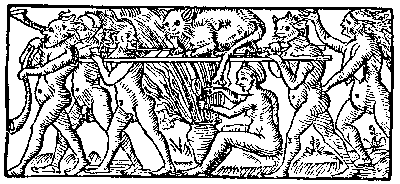
France was quiet last night. Only one school was torched and the number of “car-becues” was down to 400. Two more nights and we will be back at the normal pre-riot level of 100 car fires per night. Ah, didn’t Interior Minister Nicolas Sarkozy say earlier that “20 to 40 cars torched each night” was the normal rate?

Yes, he did, but the official figures are generally understood to be underreported. As this discussion (in French) between firemen shows, when one car is set alight but two cars next to it are destroyed in the same fire, the statistics count it as only one case of car torching, not three. And when a car is set alight, but is not damaged beyond repair, it is not included in the statistics either. Hence doubling or tripling the official figure is not considered to be unrealistic. Some people even put the number at 50,000 “car-becues” per year. This is almost 140 in a “normal” night.

How to Solve Ethnic Minority Problems in Central and Eastern Europe

As the national state evolved in the 19th century, too much emphasis was placed on it as the expression of the alleged collective characteristics of its inhabitants and on its role as the protector of their economic well being. This nationalistically coloured view of the state (notice the implications for “Big Government”) goes against the ideals of classical liberalism. The implied Leviathan reduces the chances of resistance against the dictatorship of majorities as in “people’s democratic dictatorships.” Meanwhile the awareness has faded that freedom means the right to resist, in the name of individualism, in circumscribed areas and means, the organization that claims to embody the “general will.” Accordingly, nationalism assumed that the nation and its state were automatically democratic and that individual rights did not precede it but were its upshot. Much of the issues that conservatives in our time are concerned with have their roots in this original sin of modern-day political organization.

Europe’s REACH: Costly for the World; Suicidal for Europe

suicideREACH3.jpg

The European Union is proposing to introduce a major new system for testing a large range of chemicals and substances for their effects on the environment and human health in the form of the new Registration, Evaluation and Authorisation of Chemicals (REACH) Regulation. As a Regulation, REACH will be directly applicable in all Member States once it comes into force.

“REACH will cost Europe billions of dollars and not have any benefit whatsoever,” says Angela Logomasini, Director of Risk and Environmental Policy at the Competitive Enterprise Institute, and author of a new study [pdf] by the Hayek Institute in Brussels.

The Breakdown of the Extended Order

While the riots seem to be subsiding somewhat in France, vandalism is spreading in Belgium. In Hoboken, a southern suburb of Antwerp, a truck and a bus went up in flames last night. In Antwerp-North, Lokeren, Sint-Amandsberg (a suburb of Ghent), Saint-Ghislain (a suburb of Mons) and the Brussels neighbourhoods of Molenbeek, Vorst, Anderlecht, Elsene and Sint-Lambrechts-Woluwe cars were torched. The authorities say that these are “isolated incidents.” There was no rioting, though in Anderlecht and Molenbeek molotov cocktails were thrown. In Germany eleven cars were set ablaze in Berlin and Cologne. All this is peanuts, however, compared with France, where in the 13th consecutive night of violence some 620 cars were set alight. That number, however, was half the number of the previous night (Steven Den Beste thinks that attrition might bring the French riots to an end).

Syndicate content