Cartoon Case Escalates into International Crisis

The case of the Muhammad cartoons, published by the Danish newspaper Jyllands-Posten two weeks ago, is escalating into a major conflict between Denmark and the Muslim world. Eleven Muslim ambassadors to Copenhagen, who had protested to Danish Prime Minister Anders Fogh Rasmussen demanding apologies from the newspaper, decided to take the matter to international Muslim organisations, such as the Arab League and the Organisation of the Islamic Conference.

One of the eleven ambassadors is the ambassador of Turkey. She has received full support of the Turkish Foreign Ministry in asking Rasmussen to call Jyllands-Posten to account for “abusing Islam in the name of democracy, human rights and freedom of expression.” According to Muslims it is blasphemy to depict the Prophet Muhammad.

Where Is the Beef at Hampton Court?

[inline:01]
When Zeus fell in love with young Europa, the transformed himself into a bull and abducted her. That story is fairly famous. What happened next is less well-known. Europe gave birth to a calf which grew up to be the sacred cow of the European Union. Considering the EU’s origins, it is no wonder that, from its early days, it took a particular interest in agriculture, especially beef and dairy produce.

The daughter of beautiful Europe, however, proved to be not quite as beautiful as her mother. The EU inherited some charming characteristics from Europe, but also some really ugly aspects from Father Zeus. One of these is called the Common Agricultural Policy.

Prognosticus

eurota-ecologist.jpg

In looking at the state of the environmentalism movement today, it is important to look at the past. Through many discussions and researching, one particular publication keeps coming to the front as the founding document of the modern-day environmental movement, The Ecologist. More specifically, Volume 2 Number 1, January 1972 (A Blueprint for Survival). See the entire issue for yourself here. This particular issue is viewed as ‘seminal’ to the environmental movement. Penguin Books even republished the entire edition due to ‘high demand’.

What are some of the foundations of the modern-day environmental movement provided for in this 1972 issue of the Ecologist:

The Piggy Bank Ban and Selling Out to Muslims

fp2-1.jpg

British banks are banning piggy banks because these may offend some Muslims. Halifax and NatWest banks have led the move to scrap the time-honoured symbol of saving from their children’s products and from their advertising. Muslims do not eat pork, as Islamic culture deems the pig to be an impure animal. Salim Mulla, secretary of the Lancashire Council of Mosques, backed the bank move. “This is a sensitive issue and I think the banks are simply being courteous to their customers,” he said.

Novelty pig calendars and toys are also being banned from social welfare offices in Britain. Workers in the benefits department at Dudley Council, West Midlands, were told to remove or cover up all pig-related items, including toys, porcelain figures, calendars and even a tissue box featuring Winnie the Pooh and Piglet. The pigs were offensive to Muslims during Ramadan.

Already infant schools have banned stories featuring pigs, including “The Three Little Pigs,” in case they offend Muslim children.

Parts Per Billion: Possibly the First in An Erratic Series

In researching information on how Kyoto has become the Holy Grail of environmentalists, much data has been uncovered. From time to time knowledge will be dropped into this forum. Nothing earth-shattering, just information used back in the day by our betters in the creation of the modern-day Frankenviro movement.

As a result of the UNESCO Conference on the Biosphere in 1968, environmentalism went international. Official Europe took up the UNESCO mandate at the Conservation Conference held in Strasbourg (1970). Two elements emerged from the Conference, elements undoubtedly used by governments to make decisions as it relates to taxation, economics, and regulation.

Surprise: Kaczynski Again

kaczynski.jpg
Lech and Jaroslaw. Or is it Jaroslaw and Lech?

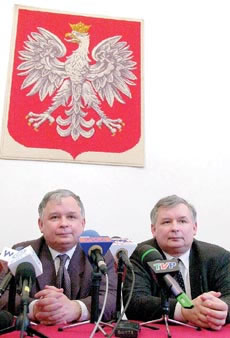
Yesterday the Poles elected Lech Kaczynski of Law and Justice (PiS) as their new president, the third to be freely elected since the Poles brought down communism in 1989. Kaczynski, the Mayor of Warsaw, beat Donald Tusk of the Civic Platform (PO) with 53% of the vote against 47% in an election in which slightly more than 50% of Poland’s 30 million eligible voters turned out. Tusk had been a favourite in the polls until late last week. The election result was a surprise and yet a déjà-vu. In last month’s parliamentary elections the same thing happened. Before the parliamentary elections it was generally assumed that PO would become the biggest party, but the elections were won by PiS’s Jaroslaw Kaczynski, Lech’s identical twin brother.

For the first time since becoming a democracy Poland now has a conservative president as well as a conservative government. The latter, a coalition of PiS and PO, is led by Kazimierz Marcinkiewicz, a bland mathematician no-one had ever heard of before. Because Jaroslaw Kaczynski is the leader of the largest party in parliament he should normally have become Prime Minister, the most powerful political position in Poland. As many Poles did not want twins in both top jobs, Jaroslaw, while remaining party leader, decided not to become PM in order not to jeopardise his brother’s chances of being elected president.

European Parliamentary Round Up

Do let me know if you find this new feature about the European Parliament interesting, if so I will try to make a habit of it.

Turks begin to get the right idea

In another of those “Don’t you know who I am” moments the latest problem to bedevil Turkey’s attempts to become part of the European Union happened a couple of days ago when a completely unknown Member of the European Parliament (MEP) was refused access to the sublime porte, due to the fact that he was not carrying his own passport, but instead his European Parliamentarian “Laissez passer”. The Turkish customs officials obviously looked at it, looked at the increasingly irate MEP prevented him from entering the country, relenting only when he paid for an entry visa and after protests by both EU officials and Greek diplomats.

EU Taxation: Highs and Lows

Press releases issued on Fridays are usually meant to be overlooked and forgotten going into the weekend. This press release from Eurostat [pdf] is probably no different, “EU25 overall tax burden at 40.3% of GDP in 2003.” This of course means that the equivalent of hundreds of billions of euros were taken from individuals and spent by government in 2003. Was some of this government spending efficient, of course. Was some of this governmental spending inefficient, absolutely.

Did this level of government taxation have any bearing on the overall economic performance of the individual EU-25 countries, decide for yourself:

Jihad Against Danish Newspaper

mohammed-illustration.jpg

Islam is no laughing matter. The Danish newspaper Jyllands-Posten is being protected by security guards and several cartoonists have gone into hiding after the newspaper published a series of twelve cartoons (see  them all here, halfway the article) about the prophet Muhammad. According to the Islam it is blasphemous to make images of the prophet. Muslim fundamentalists have threatened to bomb the paper’s offices and kill the cartoonists.

The newspaper published the cartoons when a Danish author complained that he could find no-one to illustrate his book about Muhammad. Jyllands-Posten wondered whether there were more cases of self-censorship regarding Islam in Denmark and asked twelve illustrators to draw the prophet for them. Carsten Juste, the paper’s editor, said the cartoons were a test of whether the threat of Islamic terrorism had limited the freedom of expression in Denmark.

Slovakia Bans Positive Discrimination Legislation

Last Monday the Constitutional Court in Slovakia ruled that positive discrimination, which provides advantages for people of certain ethnic or racial minority groups, is to be banned in Slovakia because it “violates full equality before the law.” The court ruling is a blow against EU policy on the matter because Brussels had forced Slovakia to introduced positive discrimination legislation.

For several months a dispute had been going on in the Slovak parliament. The government wanted to drop Article 5 of the European Council Race Discrimination Directive [pdf]. Article 5 allows the option of positive action and has been part of Slovak anti-discrimination law since July 2004. The verdict of the Constitutional Court is a victory for the governing Christian Democratic Movement (KDH). “We need to get rid of building stereotypes based on race and ethnicity,” said Daniel Lipsic, the Slovakian minister of Justice. The verdict has angered spokespeople of the 500,000 Roma living in Slovakia. They see “positive action” as a necessary means to increase the chances of the Roma to find work.

Syndicate content