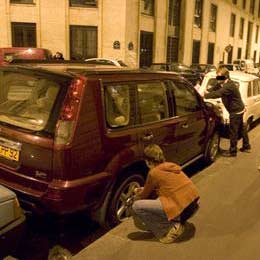
Tyre Terror

degonfles.jpg

Last weekend a gang that calls itself Les Flagadas, deflated the tyres of some forty SUVs in Brussels. The Flagadas target four-wheel-drive vehicles because they want to make a political statement: “SUVs consume a lot of gas and pollute the environment,” says a Flagadas spokesperson who describes herself as an “eco-activist.” The Brussels Flagadas draw their inspiration from a French gang, Les Dégonflés, who have deflated the tyres of dozens of four-wheel-drives in the streets of Paris since early September.

The “eco-guerrillas” maintain they are doing nothing wrong because they deflate tires without damaging the tyres, let alone the cars:

“It would be difficult to take us to court,” [the leader of the French groups says]. “We don’t slash tires, we deflate them. Air doesn’t cost anything. […] Our rules are to never run from the police. And always run from the owners.” […] The deflators are on the fringe of a movement that has considerable support in the [Paris] City Hall, which is governed by an alliance of the Socialist and Green parties.

German Elections: Compromise vs. Capitulation

It is difficult to watch the news from Germany since the elections of a month ago. Despite having a true program for economic reform and an opponent which has made the moniker “sick man of Europe” seem like an actual step-up for the German economy, the CDU/CSU has managed to deal away so much in a short period of time. Day one of coalition talks with the SPD saw the CDU/CSU capitulate on a central piece of their election manifesto:

Leaders of Germany’s proposed grand coalition on Tuesday ruled out broad-ranging tax cuts for the next four years, a move that casts doubt on the new government's courage to confront the need for economic reforms.

Grey Socialism

The Belgian trade unions are going on strike next week against the plan of the government to raise the minimum retirement age to 58 (at present one can retire at 55). In Belgium fewer than 30% of the population between 55 and 64 years of age are in work. The EU average (2003) is 40.2%, with only Sweden, Denmark, the United Kingdom, Estonia and Portugal above 50%.

Last month the German voters made a center-right coalition of the Christian-Democrats and the free-market Liberals impossible, thereby thwarting plans to reform the welfare system and make it less generous. In France Prime Minister Dominique de Villepin, a dandy without convictions who has never been elected to public office, is becoming popular by depicting his rival, Nicolas Sarkozy, as a dangerous reformer who wants to cut back the welfare state. Like the Belgians and the Germans, the French do not want to give up the “social rights” to which they feel they are entitled.

Does Condi Realize the Danger of Europe's Anti-Americanism?

Condi.jpg

The inaugural issue of the new American quarterly The American Interest (Autumn 2005) includes an interview with Secretary of State Condoleezza Rice. In the course of the conversation AI editor Adam Garfinkle asks Rice a question on anti-Americanism:

During the Cold War we were all familiar with varieties of anti-Americanism, mostly on the Left. A lot of people now claim that not only is there more anti-Americanism, but that its sources are more diverse. Do you think that’s so and if you do, where does this new anti-Americanism come from? Is it just a reaction to American conduct after the 9/11 attacks or is it because we’re No. 1 and there’s a natural envy? What do you think accounts for it?

It is a very pertinent question and it goes to the roots of one of the major problems confronting Europe but also America today, with not only political but also economic consequences. Is there more anti-Americanism today than before? Are its sources more diverse? Where does the new anti-Americanism come from? Is it a reaction to America’s reaction to 9/11? Or is it envy? What does the leading American foreign policy maker think? These were the things Garfinkle asked, but, unfortunately, Rice did not answer. What she said was as evasive as it was trivial:

I think people have to be more rigorous about what they mean by anti-Americanism. Clearly this is still the most popular place in the world to come if you want to be educated, or if you want to immigrate. The United States is still a pretty popular place. American culture, both good and bad, is very much sought after abroad. And I still think that the values of the United States are the most universal of all values.

Rewards of Economic Freedom

Which freedoms are the most important?

If you had to list 10 freedoms that are important to you from your most to your least important, how would you rank them? You might ask your family and friends the same question, and I expect you will find the lists and priorities quite different.

Those who work in the media are likely to rank freedom of the press near the top. Civil libertarians are likely to put the right of peaceable assembly, the right against self-incrimination and the right against unreasonable search and seizures on their list. Hunters are likely to rank high the right to bear arms, while city dwellers may not list it at all.

New Government Takes Over. Wolves Satisfied With Minister

For the first time after two decades Norway again has a majority government. The last government supported by a majority in Parliament was that of the conservative Prime Minister Kare Willoch, who governed from 1983 to 1985. The new government, led by the Social-Democrat Jens Stoltenberg, is the very first coalition of red (i.e. Socialists) and green (i.e. Environmentalists). Though the parties of the right won more votes than the parties of the left in last September’s elections, the left got more seats than the right.

Today Stoltenberg presented his new cabinet to King Harald V. The new cabinet consists of 19 ministers, ten men and nine women. Among the women is Helen Bjørnøy, an ordained minister who recently lost her bid to be the new (Lutheran) Bishop of Oslo. Instead, the minister will now be a minister. Bjørnøy, a member of the far-left Socialist Left Party, is Norway’s new minister of the Environment.

Good News for Garlic Coalition

Yesterday’s Estonian municipal elections have resulted in considerable gains for the Reform Party (12.2 to 16.9%) of Prime Minister Andrus Ansip, moderate gains for the Estonian People’s Union (11.2 to 12.5%), Mart Laar’s Pro Patria Union (6.2 to 8.6%) and the Social-Democratic Party (4.4 to 6.4%), a status-quo for the Center Party (from 25.9 to 25.5%) and significant losses for Res Publica (15.2 to 8.5%) and the United Russian People’s Party (4.3 to 0.7%).

The municipal elections are good news for the national government – the so-called “garlic coalition” – which is a coalition of the Center Party, the Reform Party and the Estonian People’s Union. The coalition gets its name from having been forged by the party leaders in a restaurant which specializes in garlic dishes (a good idea: you can outstink the opposition). The elections are a disaster for Res Publica, the party of Juhan Parts, who was Prime Minister until April 2005, and for the party of the Russian nationalists. Ethnic Russians make up a quarter of the Estonian population.

Europe, America, and Politics Without God

[inline:03]
The cube and the cathedral
George Weigel, a Senior Fellow of the Ethics and Public Policy Center in Washington, D.C., is the well-known biographer of the late Pope. In 1999 he wrote the international bestseller Witness to Hope: The Biography of Pope John Paul II, which was widely translated. Weigel has just written a new book The Cube and the Cathedral: Europe, America and Politics Without God. The cathedral in the title is the Notre Dame in Paris and the cube the modern Great Arch of La Défense in the same city. The latter houses the Foundation for Human Rights, in accordance with the intention of the former French president François Mitterrand when he had the building constructed to celebrate the 200th anniversary of the French Revolution of 1789.

George Weigel on Europe & America, “red” & “blue”, demographic suicide, Christians in the culture war, and Turkey in the EU
The Brussels Journal interviewed George Weigel about his new book, in which he tackles what he calls “Europe’s problem.” According to Weigel Europe is dying in the most literal sense: it is depopulating itself. Why is a continent that is richer, healthier and more secure than ever before failing to create the human future in the most elemental sense of creating successive generations? According to Weigel, a Roman Catholic theologian, Europe’s problem has to do with the loss of the cult at the heart of the culture.

Baltic Democracy, a Concept under Fire

A series of opionion polls last week must have dimmed the lights in the ECOFIN corridor in the Justus Lipsius building. Even the Trickster himself back in Frankfurt might allow himself a wry smile. It seems that the good peoples of the Baltics are not as convinced as their political classes of the efficacy of the Euro to solve their ills.

In Estonia the government plans to introduce the currency in just over a year, January 1st 2007. However according to a poll carried out by Emor it seems that they have yet to convince their population. 48% oppose the Euro, with 47% in favour (only 5% don’t know, pretty impressive). Damned close but just the wrong side of democratic legitimacy, I think you would agree.

EU Economies: Poor Reporting

It is always interesting to see our friends on the left hit the roof when data is presented. The beauty of data can be summed up quite easily, it is what it is. The number 7 is 7. There is no “yes, but”, there is no Lakoffian reframing of 7 as 6.2, there is no getting around the true fact that 7 is and will always be 7. It is this certainty in an oft-cited “world of grays” by the extreme Left that seems to be so repellent.

Syndicate content