Homosexuality And European Values

This week, on 19 January to be more precise, the European Parliament issued a resolution, submitted by the socialist, green, liberal and communist fractions (the "European pink"), condemning Lithuania for its alleged discrimination of homosexuals, and calling on the Lithuanian parliament to withdraw a draft law that would punish the "public promotion of homosexuality".  According to the authors, their resolution was triggered by "a series of worrying events" like the adoption of a Law on the protection of minors against the detrimental effects of public information and an attempted ban by local authorities on holding gay pride marches.  In the future, gay prides should be allowed everywhere and minors should be able to access information about homosexuality freely.

No Democracy Without National Identity

A quote from Daniel Hannan in the European Parliament, 19 January 2011, reading from his book "The New Road To Serfdom - A Letter Of Warning to America":

Faced with a choice between democracy and supra-nationalism, the European Union almost always opts for supra-nationalism and nowhere is this clearer than in its policy in the Western Balkans. We are maintaining to all intents and purposes protectorates in Bosnia, in Kosovo and arguably even in Macedonia for the sole purpose of preventing ethnographic boundaries along the lines of what local people there would choose.

History As An Aesthetic Phenomenon

This is Part 3 of "'I See Further Than Others': Reflections On Oswald Spengler's The Decline of the West and The Hour of Decision", a serial essay by Steve Kogan.

In translation, “the decline of the west” recalls Edward Gibbon's “the decline and fall of the Roman empire,” but “der untergang des abendlandes” projects an image of time and space in the decline of "the evening lands," hence the "twilight of the west" (1). To visualize the title in this way is to prepare oneself for what follows, for it is not an introduction to a narrative or a theory of history but an image that evokes a particular region at a particular time of day, and it expresses an entire world view by association with the earth and sky. Myths are made of such stuff, as Spengler underscores in his many discussions of the early high cultures, and they are also the key to his "soul-portraits" of history, which he depicts in view of Nietzsche’s writings on the Olympian myths and the mythopoeic imagination.

The Punishment For Insulting The Prophet

It is getting boring, dear reader, but that's not my doing: the facts happen to repeat themselves simply because the underlying motivation remains the same, namely Islam. In the Pakistani capital Islamabad Taseer Salman, the governor of the province of Panjab, also publisher of a liberal newspaper, was assassinated. He had uttered a negative opinion on the law on blasphemy, which especially imposes a penalty for insults to the Prophet Muhammad prohibited. He had visited Aasia Bibi in jail, a Christian woman convicted for insulting the Prophet, and had promised her to plead for pardon with the President.

Lessons From Tunisia

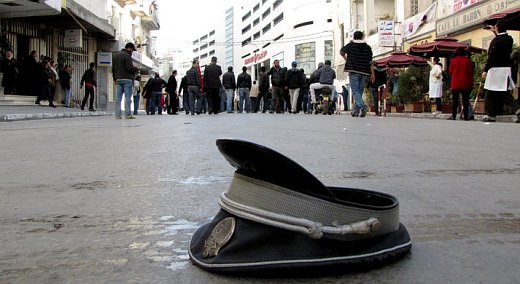
tunisia-kepi.jpg

French leaders have for long agreed with "experts" that there will be no changes in any "Arab" country, as long as the Israeli-Palestinian conflict has not been settled. I'm referring to "experts" such as geostrategist Pascal Boniface, former minister of foreign affairs Hubert Védrine and their friends of the BDS ("Boycott, Divestment and Sanctions for Palestine") who recently pressured singer Vanessa Paradis into canceling her visit to Israel

Now the Tunisian rebellion has uncovered the plot. The fate of the Tunisian people was indeed miserable, but not because their leaders were transferring many products to the Palestinians to allow them to survive, as I have personally heard the wife of former Tunisian president Ben Ali say in 2002 on the French-language radio station during a stay in Djerba: she spoke of "necessary sacrifices" to support the effort of the Palestinian people. 

Free Speech On Trial In France

eric-zemmour.gif
Eric Zemmour

An article at François Desouche reviews the story of journalist Eric Zemmour's comments about race and crime, a media event from March 2010 that led to a trial for defamation and racial discrimination. The trial is now in session. The comment that may cost Zemmour some money, if not his personal freedom was:

French immigrants are more closely monitored than others because most drug dealers are blacks or Arabs... It's a fact.

The Gluttons Got Inside the Cookie Jar

Why to avoid the stampede into the European Union. Exchange rates. Membership, pretentions and the benefits.

1. The appetite of the European Union to expand is abating. Even Brussels seems to realize that quantity does not substitute for quality. Refusing Romania’s and Bulgaria’s adhesion to the Schengen Treaty -it eliminates border passport control- is symptomatic. The abolition of “borders” among members places a burden on countries bordering non-members. These are being deputized to protect their outside borders in behalf of the EU.

Sunflowers And Human Rights

kevin-rudd-yad-vashem-sunflowers-2011-01-13_1626.jpg

When the Australian foreign minister Kevin Rudd visited Israel recently, he brought a wrath of sunflowers to Yad Vashem, the Holocaust museum in the country that had become a safe heaven for Jews. Of course this was the Australian ex-Prime Minister who was toppled at the face of it for his broken promise to tackle climate change. I will try to show here that he - for reasons I don't know yet - touched on an enigmatic issue that could have some important implications. For what might falter down under is still very much alive elsewhere. The German Greens, now the second largest party, will have a lot more clout soon to implement their target of running Europes biggest economy on 100% “clean” energy by 2050. They have already set the standards for the anti-Western renewable energy revolution by rejecting the most sensible nuclear power option at all costs. The sunflower has come to symbolize this irrational obsession in the West which is probably best explained as a remote echo of Hitlers engrained anti-nuclear bias.

Rhythms of History (2)

This is Part 2 (B) of "'I See Further Than Others': Reflections On Oswald Spengler's The Decline of the West and The Hour of Decision", a serial essay by Steve Kogan.

In his early notebooks and The Birth of Tragedy (1872), Nietzsche draws a sharp line between aesthetic understanding and systematic thought, a distinction that informs his philosophical argument on the limits of science and objective research. Guided by his critique, Spengler questioned the scientific model of historiography in German education, in which history was now 

seen as Nature (in the objective sense of the physicist) and treated accordingly . . . The habits of the scientific researcher were eagerly taken as a model, and if, from time to time, some student asked what Gothic, or Islam, or the Polis was, no one inquired why such symbols of something living inevitably appeared just then, in that form, and for that space of time. Historians were content, whenever they met one of the innumerable similarities between widely discrete historical phenomena, simply to register it, adding some clever remarks as to the marvels of coincidence, dubbing Rhodes the "Venice of Antiquity" and Napoleon the "modern Alexander," or the like; yet it was just these cases . . . that needed to be treated with all possible seriousness . . . in order to find out what strangely-constituted necessity, so completely alien to the causal, was at work.

Blinded By The Anti-American Obsession

Some French intellectuals and journalists like Bernard-Henri Lévy, Patrick Poivre d’Arvor, Régis Debray and Dominique Souchier are clinging to straws while drowning. They will do anything to save themselves from oblivion, while they have nothing more to say than their usual discourse.  And the best way to succeed is to bash America, to lecture it, or to steal from it by way of plagiarism. 

Now they go so far as to blame the fate of the Christians in the Middle East on the Bush presidency. That is what French Communist intellectual Régis Debray did last Saturday in an interview by Dominique Souchier on Europe 1 radio.  The truth is that the situation of the Christians in the Middle East has been deteriorating since the end of the 1980s, more precisely: since the Iranian Khomeiny revolution - which is currently repeating itself in Lebanon.  This, as well as the fate of the Copts in Egypt or the disturbances in Pakistan (similar to the uproar in Algeria in the 1990s) have nothing to do with the Bush presidency nor with Israel, contrary to what Debray believes.

Syndicate content