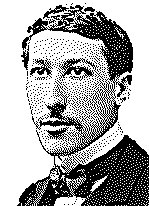
René Guénon in 1925
The Conservative
critique of modernity is by no means a recent phenomenon; it begins rather with
the responders to Jean-Jacques Rousseau and his Jacobin followers in the late
Eighteenth Century. It is sufficient in
this regard to mention the names of
Edmund Burke (1729 – 1797) and
Joseph de Maistre (1753 – 1821) and of
their successors,
S. T. Coleridge
(1772 – 1834) and
François-René de Chateaubriand
(1768 – 1848), to suggest the range and richness of immediately
post-revolutionary conservative discourse.
In the Twentieth Century,
José Ortega y Gassett
(1883 – 1955),
Oswald Spengler
(1886 – 1936), and
T. S. Eliot (1888 –
1965), among others, continued in the line established by French
réactionisme. In Ortega’s case and
in Spengler’s this continuation entailed incorporating the iconoclastic
skepticism of Friedrich Nietzsche into the discourse qualifiedly. In Eliot’s case, it meant rejecting
Nietzsche’s atheism and taking up from Chateaubriand and Coleridge the apology
for Christian revelation and for a theological, as opposed to a secular, view
of existence. René Guénon (1886 – 1951)
belongs by his dates with the generation of Ortega, Spengler, and Eliot; like
Eliot, Guénon is a theist, but despite his favorable treatment of Catholicism
he is less identifiably Christian than Eliot.
Guénon sees Catholicism as the vessel of tradition in the West, but
elsewhere tradition has
other forms that are valid in their own
contexts.
[i]
Spengler’s Decline
of the West undoubtedly made an impression on Guénon, much as it did on
Guenon’s younger contemporary Julius Evola (1898
– 1974). Guénon and Evola knew each
other and mutually influenced one other.[ii] Both Guénon and Evola together exemplify a
branch of modern critical anti-modernism affiliated much more than casually
with the Twentieth Century occult revival.
Guénon at one time, in the 1920s, edited the chief French-language
occult periodical, La Gnose or “Gnosis.” Yet Guénon, a fierce
un-masker of religious mountebanks, can hardly be accused of employing mystic
obscurantism to push a doctrinaire agenda.
Guénon’s interest in occult topics, even more than Evola’s, strikes one
as rigorous and objective. As for
Guénon’s awareness of ideological deformations of reality, it ran to the
acute. The driving force of deformation,
in Guénon’s analysis as in Evola’s, is the stultifying massiveness of modern
society, with its conformism on an unprecedented scale, and its receptivity to
oratorical manipulation.