Duly Noted: Statues, History And Reality

bj-logo-handlery.gif

How modern concerns can produce a faceless past. More about the Polanski case. Why they can “do what they want”. An analogy that is none. Is equality served if, regardless of their differences, all get the same?
 
1. A presumably overlooked news item tells that in Bradford (VA, USA) a memorial for WW2’s leaders has been built. That FDR, Churchill is part of the exposition is normal. Equally appropriate would be Chiang Kai-shek or even de Gaulle. Others that did not head major countries could also be nominated.

 

Duly Noted: Inconvenient Realities

bj-logo-handlery.gif
Collectivism and its record: consistently downward. The politics of the economic downturn: Is cause and effect filed in the right order? An incredible suit. Is the one that resists encroachments a troublemaker? What the recent spy case tells – about us.


1. In a side comment, “The Economist” (to this writer the world’s best weekly) mentioned that, regardless of its ups and downs, Americans prefer Capitalism to Socialism. This is apparently so because, even if they lack personal experience, the Yanks seem to be aware that Socialism has a consistent record. Its arrow points south.

A History of Astrophysics, Part 5

Even after the introduction of the telescope it took centuries for Western astronomers to work out the true scale of the universe. The English astronomer and architect Thomas Wright (1711-1786) suggested around 1750 that the Milky Way was a disk-like system of stars and that there were other star systems similar to it, only very far away from us. Soon after, Immanuel Kant in 1755 hypothesized that the Solar System is part of a huge, lens-shaped collection of stars and that similar such “island universes” exist elsewhere, too. Kant’s thoughts about the universe, however, were philosophical and had little observational content.

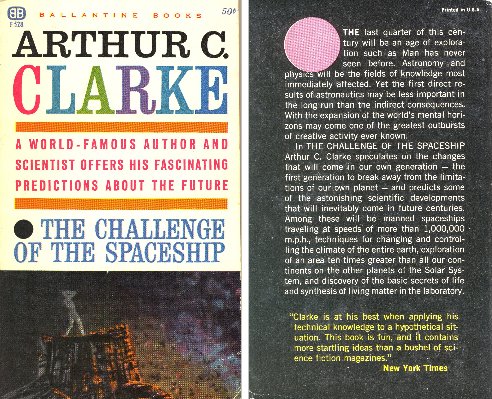
The Challenge Of The Spaceship: Spaceflight As It Should Have Been And As It Was

bertonn-space-1.jpg

The phrase “The Challenge of the Spaceship” is the title of an early 1950s popular science article by the late Arthur C. Clarke (1917-2008), best known as the scenarist for Stanley Kubrick’s enigmatic space travel film 2001: A Space Odyssey (1968); Clarke, a radio-electronics engineer who switched to writing science fiction stories in the late 1940s and became a dean of the genre, used the title again when he anthologized that article with a dozen others for book publication in 1955. (There were republications with additional material in subsequent years.) With other science fiction writers – like John W. Campbell, Robert A. Heinlein, and Isaac Asimov – Clarke helped immensely to inspire the actual space program in the West, chiefly of course in the United States. The boredom of the Space Shuttle in service and the pointlessness of its destination the International Space Station have consigned to oblivion the memory of the actual space program, the climax of which came with the moon landings of the three years 1969 to 1972. NASA, fully complicit in the public’s indifference to its bailiwick, still sends robotic probes to the planets and moons, with diverting results, but has long since lost the courage necessary for manned exploration of the solar system.

Umbrellas for Fish

bj-logo-handlery.gif
Umbrellas for the fish. Share the wealth, or prevent its creation. Regulation and unfreedom. The supposed racism of laws that apply to all. Utopias and giving predictable failure a second chance. The hope of getting a hot meal from the EU. Self-induced bad governance and responsibility.

Anti-Israel ‘Lawfare’ in Europe

eu-israel-small.jpg
Pro-Palestinian activists are launching a new round of anti-Israel lawsuits in European courts. The lawsuits, which exploit the legal principle of universal jurisdiction, are being used to harass current and former Israeli political and military leaders, with the twin aims of tying Israel’s hands against Palestinian terror and delegitimizing the Jewish state.

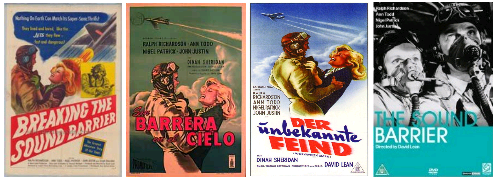
A Conservative Obligation: David Lean’s The Sound Barrier

aircraft-bertonn-1.png

Cinema means movement, hence the nickname, “motion pictures.” Right from its beginning in Eadweard Muybridge’s stop-motion films of horses – and of male and female nudes – the “movie camera” has demonstrated understandable fondness for things robustly animate, the more impressive the hyper-kinesis the better. Visiting aliens might be excused for thinking that the main subjects of film are the galloping horse, the steam locomotive, the automobile, and the flying machine. A remarkable Georges Méliès (1861-1936) production based loosely on Jules Verne, Le voyage à travers l’impossible (1904), deploys all of these modes of transportation in a mélange of mechanical and transcontinental fantasies in the auteur’s inimitable style. [Clip] In the aftermath of “The Great War” (1914-1918), filmmakers began to see the possibility of theatrical spectacle in aeronautics. For Wings (1927), director William Wellman (1896-1975) put together an air force in San Antonio, Texas, that must have rivaled the United States Army Air Corps of the time; he installed cameras in a variety of “platform” aircraft and shot “dog fights” (below) of astonishing realism. [Clip]

Fitting the Marxist Patterns

bj-logo-handlery.gif
Chavez’ solutions nurture his problems. An unwelcome candidate in Germany. The unmentionable Near Eastern solution is gaining acceptance. Who is willing to evict whom? Returning to conditions your family had escaped. Choosing between a community of blood or one of common purpose. Is “leftist peace activist” an oxymoron?


1.When Chavez nationalizes an industry, he is engaging in a political and not an economic action as he puts enterprises under political control. In his case, “politics” mean “Chavez”. Louis 16th said that “I am the state” and in the Venezuelan reality that imitates the Sun King, the public realm has become identical with the Bolivarian “Leader’s” eccentric whims. When such nationalizations occur, the accompanying commentary tends to note that Venezuela’s problems made the Chavists to take control of new enterprises. This cause and effect relationship can be turned around. Wanting to comprehend reality the conditional “can” might even need to be translated into an imperative “must”.

The Fall of the Belgian Church

In Belgium, today, police searched the residence of the Archbishop of Mechelen-Brussels and the crypt of the Archbishop’s cathedral in Mechelen. They were looking for evidence of cover-ups in the ongoing investigation into widespread pedophilia practices within the Belgian church in the decades during which Cardinal Godfried Danneels was Archbishop. Danneels retired in January of this year.

Canary in the Coalmine: Europe’s “Decoy Jews”

“Decoy Jew” is a new phrase in the Netherlands. Jews are no longer safe in major Dutch cities such as Amsterdam. Since 1999, Jewish organizations in the Netherlands have been complaining that Jews who walk the Dutch streets wearing skullcaps risk verbal and physical attacks by young Muslims. Being insulted, spat at or attacked are some of the risks associated with being recognizable as a Jew in contemporary Western Europe.

Syndicate content