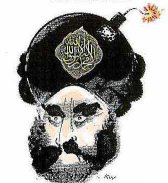
Toxic Islam - A Food Theory of Culture

I have been developing a "food theory of culture" with one of my friends. A good meal should consist of a variety of foods. Even excellent ingredients will become boring if you rely on just one or two of them all the time. What makes a fine meal is not just fine ingredients and a competent cook but the overall balance between the various ingredients, where the totality is greater than the sum of the parts. You need something salty, something sweet, something spicy and something refreshing. Focusing on each individual component and stating with certainty that “this is the thing that created the success” is a mistake, but a very common one.

A History of Mathematical Astronomy - Part 4

european-achievements.jpg
The Scottish theologian and mathematician John Napier (1550-1617) studied at the University of St Andrews, the oldest university in Scotland, and spent several years in Continental Europe. He invented logarithms, a mathematical device which simplified and speeded up manual calculations and aided the work of scholars for centuries. This inspired the invention of the slide rule during the 1600s, which was excellent for multiplication and division and the calculation of powers and roots. The Apollo lunar program in the United States as late as the 1960s kept slide rules as backups for their electronic calculators. Napier improved and popularized the decimal notation introduced by the Flemish mathematician Simon Stevin.

Duly Noted: The Frustrated Immigrant

bj-logo-handlery.gif
George Handlery about the week that was. An ailment of our culture? Terrorism is a calling: Even released terrorists remain in the business. Two reactions to underdevelopment. Self-exclusion and the frustrated immigrant.

1. Shocking is that this will not shock. The suppressed ability to show natural outrage is a symptom of the ailment of our culture. Reports have asserted something disturbing about Antonio Samaranch who used to head the International Olympic Committee (1980-2001). Keep in mind that, even if you are probably taught that sport is sport and politics are politics, modern dictatorships use sports to prove the superiority of their system. Now those who had always felt that he was too chummy with the Kremlin are having the facts that confirm their earlier discomfort. The once Franco-man used to be the Minister of Sport. (Did the blemish of his past make him respond to pressure?) Then he became Ambassador to the USSR. Having been involved in a smuggling affair, he is said to have become vulnerable. The predicament led to extortion and that was followed by compliance. The individual case is also a reflection of the fact that Western governments and social institutions, as well as international organizations, were shot through with individuals who, under duress or by conviction, served Communism’s cause.

No Western Assault Rapists in Oslo's Streets

The police in the Norwegian capital Oslo revealed that 2009 set yet another record: compared to 2008, there were twice as many cases of assault rapes. In each and every case, not only in 2008 and 2009 but also in 2007, the offender was a non-Western immigrant. At the same time, in 9 out of 10 cases, the victim was Norwegian, not just by nationality, but also by ethnicity.

Before Camus: Gustave Le Bon on ‘The World in Revolt’

Albert Camus’ L’Homme revolté [Man in Revolt] or The Rebel (1951) is a milestone of postwar philosophical writing, widely admired for its diagnosis of a combat-shattered, God-deprived, ideologically disgruntled world. In The Rebel Camus (1913-1960) was distancing himself from Existentialism – that of Sartre, anyway – in favor of something more like a tradition-rooted perspective. Existentialism had already caricatured itself in the early 1950s so that its slogans might serve undergraduates and taxicab drivers. Camus quoted at length from Friedrich Nietzsche and Fyodor Dostoyevsky; he reiterated that modernity itself was askew and had become bitterly unsatisfying to those caught up in its tenacious grip. Despite his range of reference, however, Camus makes no mention in The Rebel of Gustave Le Bon (1841-1931), author of The Psychology of Revolution (1895) and The Crowd: A Study of the Popular Mind (1896). Nevertheless Le Bon’s sharp-eyed meditations prefigure Camus’ “Absurdist” critique of society and culture, but from a non-disgruntled and distinctly rightwing point of view. Le Bon’s World in Revolt: A Psychological Study of our Times (1920) even anticipated Camus’ title. Le Bon’s follow-up, Le déséquilibre du monde [The Disequilibrium of the World] (1923) offered a trope – that of vertigo – which the Existentialists, including Camus, would eagerly receive and exploit. Camus’ protagonist in The Stranger, Mersault, feels such dizziness just before he murders a random Arab on the Algerian beach.

A History of Mathematical Astronomy - Part 3

european-achievements.jpg
Isaac Newton, perhaps the greatest scientist the world has ever seen, was born in Woolsthorpe, a village in Lincolnshire, England, into a family of farmers. His father owned property and animals and was not poor, but he was illiterate. Newton lost his father before birth. His mother soon remarried, and Isaac was effectively separated from her during most of his childhood, left in the care of his maternal grandmother. Some biographers trace the emotional instability he sometimes demonstrated as an adult back to insecurities he experienced in his childhood. Unlike his father he got an education. At the grammar school in Grantham he gained a firm command of Latin. In the words of biographer James Gleick:

The Sailor and the Survivor Go to Washington

If you are on anyone’s mass e-mail list, by now you’ve probably heard of Harold B. Estes. For those of you who delete anything not work-related before reading, Estes is a very sharp-witted, conservative WWII vet in his mid-90’s who wrote a strong letter of criticism to President Obama, virally distributed by e-mail in November.

Brush Up Your Sharia (Apologies to Cole Porter)

dianawest-1b.jpg

Tragically, but darkly comically also, this counts as news: The Norwegian newspaper Aftenposten printed Kurt Westergaard's Motoon yesterday along with five other of the12 original Danish Motoons. As the Telegraph recaps (without running the cartoon as an illustration):

On Jan 2, an axe-wielding 28-year-old man broke into Westergaard's home screaming for "revenge" and "blood". Police - alerted by the cartoonist who had hidden in a panic room - shot and arrested him.

Aftenposten's editor, Hilde Haugsgjerd, said it seemed "natural and justified to republish the artistic and journalistic body of work that is likely the cause of this violence".

Aftenposten first published copies of the cartoons in 2005 ...

Duly Noted: The Skipped Revolution

bj-logo-handlery.gif
George Handlery about the week that was. The Left is not against the unshared good life of some but against the good life as such. Frustrated elites and their disdain for the middle class. The masses refuse their redeemers. Who does not trust the common man? When words fail: the propaganda of deeds. If you are overheard in life, you can exit with a big bang.

1. Critics of the West and of the way of life that the industrial age has made possible abound. Outstanding examples are the Socialists and the Greens, the former’s hobby gardening and composting section. Such groupings are not against the good life attained by what they insist can be a minority only. Nor is their real priority to redistribute from the top to the “starving masses”. Neither is the core of the platform to accomplish the pursuit of their version of justice. That would be taking from the “rich” and giving to the “poor” -allocating a bit for themselves to finance the efforts of those that administer the scheme. What this element is really committed to combat is not supposed injustice, which is inherent in any inequality, but the “good life” as such. (Anyhow, life is a pollutant.)

A History of Mathematical Astronomy - Part 2

european-achievements.jpg

Ancient Greek planetary theory was brought into its final, very successful form with Ptolemy’s masterpiece in Alexandria in the second century AD. James Evans explains in his book The History and Practice of Ancient Astronomy:

“The original title was something like The 13 Books of the Mathematical Composition of Claudius Ptolemy. Later the work may simply have been known as Megale Syntaxis, the Great Composition. The superlative form of the Greek megale (great) is megiste. Arabic astronomers of the early Middle Ages joined to this the Arabic article al-, giving al-megiste, which was later corrupted by medieval Latin writers to Almagest….The Almagest is one of the greatest books in the whole history of the sciences – comparable in its significance and influence to Euclid’s Elements, Newton’s Principia, or Darwin’s Origin of Species.”

Syndicate content