
Astarte and Amaterasu - The Diverging Destinies of Europe and Japan. -- Part 2
From the desk of Takuan Seiyo on Fri, 2008-05-02 09:51
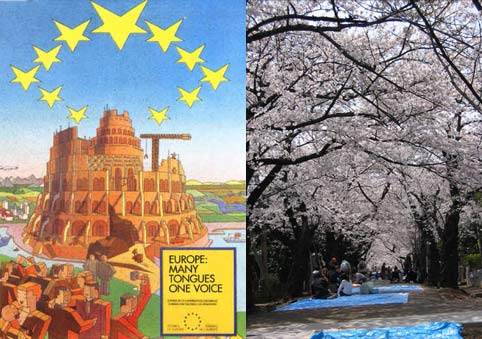
Left: An EU poster illustrating the goal of completing (see crane) the building of the Tower of Babel as per the iconic Pieter Brueghel painting.
Right: Hanami – a cherry blossom viewing party in Tokyo (photo by the author)
In the 1st part of this essay, we hypothesized that the European civilization, both in the mother continent and in its diaspora, is pursuing a path of gradual self-obliteration for reasons rooted in a deep, collective psychosis. We stated further that Japan has similar reasons to have acquired a deep collective psychosis, yet it is pursuing the path of life. We will try here to shed some light on the possible reasons for this divergence.
There is a wonderful if anecdotal quote from the great Euro-Chilean-Mexican-Parisian film director and polymath, Alejandro Jodorowsky: "One day, someone showed me a glass of water that was half full. And he said, 'Is it half full or half empty?' So I drank the water. No more problem."
Jodorowsky's aphorism sums up the difference in the mental landscapes of the West (1) and the East. The West has sat for decades now, tortured, hunched under the weight of its past follies and malfeasances, pondering a skull, a glass half full. "To be or not to be?" It has decided, as per its intellectual seers, that the white race is the cancer of human history (2). It has decided not to be.
Instead, the West has constructed a "false self." The false self is a psychoanalytic concept: a process whereby an individual who has received a profound narcissistic wound constructs a false self that allows him to pretend to be what he would have liked to be (3). So, in remorse over the distant past – whether the 30-Years-War or the Great War, slavery or colonialism, Habsburg, Himmler or Hiroshima – Western elites are building a new model of society.
This society-in-development is designed to exclude war and violence. All its people are equal and no one is allowed to discriminate. Actually, there is no longer "its people," as all of humanity is its people and "diversity" is its mantra. Gender and race are discredited concepts, not parameters of a physical reality. Racism, sexism and homophobia are capital crimes, but mass murderers are excused on account of addiction to candy or the "racism" of their victims. All social typology and taxonomy – the dreaded "stereotypes" – are outlawed, except "whitey," "fascist" and "the rich." "Nation" and "Christian" are bad words leading to censure. The ethnic expression and solidarity of people of European origin is to be suppressed; those of other ethnicities, promoted.
The low shall be high and the high shall be low. The deviant, the alien and the alienated, the parasitic and the criminal shall be high. The normal, the homegrown and well adjusted, the productive and the law-abiding shall be low. It's the reign of allophilia – the self-asphyxiating veneration of "the other," pushed by the West's political elites and its cultural Brahmins as the new panacea.
And these are the views not only of the extreme European left, and the world-spanning white liberal creed, but even of such "conservative" American aristocrats as George W. Bush and John McCain – give or take a war and a Sunday church attendance or two. It's an across-the-board fogging of the collective mind, and rotting of the collective heart, of the European civilization. The final untergang des abendlandes.
This "false-self West" has about as much grounding in human nature, down to the molecular level, as Marxism had. And the implementation of this tyrannical madness is a hundred-year project with an equal chance of success and an equal cost of implementation, in human lives and wellbeing, as Marxism has had. That is what comes from pondering the emptiness of the half-full glass, ignoring and denigrating its half-fullness.
For the credit column of the European peoples' karmic ledger includes a religion based in love, forgiveness, hope and charity – however under-implemented in the past and over-applied in the present. Inspired by that religion, Europeans have produced the greatest music and painting and most of the greatest architecture ever conceived by man; and the world's greatest literature and drama; and all the advances that humanity has made in the realms of justice, freedom, and man's inherent dignity in the last 2000 years. And, ultimately, on this side of the ledger belongs practically all the brainwork of mankind that has borne modern science, medicine, technology and all the advances in humanity's material wellbeing in the last 500 years, save for those the Japanese have made in the last 50. All relevant no more, silenced by the synchronized groans of Mea Culpa.
The Japanese, on the other hand, whose moral glass has been just as half full as the European peoples' has been, just drank the water. No more problem. And that's what one experiences living in Japan, as opposed to the degrading self-abasement and conscious self-dismantling one witnesses every day in the West.
Asked whether the dog has Buddha's nature, the Oriental sage lifts his leg to urinate on the questioner. And he will do so within a split second from the posing of the question. To arrive at this answer it will have taken him twenty years of shutting down the chatter of his mind, to align with his True Nature through arduous meditation.
The Western sage, facing the same question but having devoted his twenty years to acquiring a PhD in the hermeneutics of Jacques Lacan as applied to the transgender community's anal anxiety, will spend a year researching canine physiology and behavior, and another year reading scholarly works on Buddhism published in German, French and English since 1860. He will then write a book deconstructing the dog as a genetically programmed biological computer designed as a receptacle for the white man's proclivity for domination and exploitation.
The book will be published by a major imprint. It will receive glowing reviews in the New York Times, the Guardian and Le Monde. Herr Professor Doctor will be interviewed by BBC International and CNN. Soon the book will be on the college curriculum compulsory reading list throughout the Euroculture zone: from Sydney, Australia to Salzburg, Austria. Poisoning the minds of current voters and future leaders with the intellectual equivalent of Herr Professor's enema. Moreover, the European Parliament, quoting this book on the dais, will enact 168 new pet regulations, leading, eventually, to banning dog ownership altogether across the European Union.
The Orientals have no interest in and do not allow such rubbish. Let the stupid gaijin flock to Western Universities on the taxpayer's subsidy to take academic courses with titles like The Phallus, Queer Musicology, Blackness, Nonviolent Responses to Terrorism, and Drag: Theories of Transgenderism and Performance. In Japan, Korea and China, equally, one goes to university not to masturbate for four years at society's expense but to study nano and bio technology, medicine, and other useful things.
The book that has been the moral and sociopolitical guide of the Orient for 2500 years begins this way:
Is it not pleasant to learn with a constant perseverance and application? Is it not delightful to have friends coming from distant quarters? Is he not a man of complete virtue, who feels no discomposure though men may take no note of him?
But the book that was the moral and sociopolitical guide of Western Civilization for 1800 years begins this way:
The book of the generation of Jesus Christ, the son of David, the son of Abraham. Abraham begat Isaac; and Isaac begat Jacob; and Jacob begat Judas and his brethren; And Judas begat Phares and Zara of Thamar; and Phares begat Esrom; and Esrom begat Aram; And Aram begat Aminadab; and Aminadab begat Naasson; and Naasson begat Salmon; And Salmon begat Booz of Rachab; and Booz begat Obed of Ruth; and Obed begat Jesse;
Finding this book increasingly boring, Western civilization replaced it with two, written in the 19th century. The one begins thus:
The wealth of those societies in which the capitalist mode of production prevails, presents itself as “an immense accumulation of commodities,” its unit being a single commodity. Our investigation must therefore begin with the analysis of a commodity.
And the other, thus (4):
In the following pages I shall demonstrate that there is a psychological technique which makes it possible to interpret dreams, and that on the application of this technique every dream will reveal itself as a psychological structure, full of significance, and one which may be assigned to a specific place in the psychic activities of the waking state.
The East is governed by the direct perception of reality; the West by zealously enforced theories that purport to represent reality. It's the earthy voice of Amaterasu versus the muzzled croak of Astarte-Europa. When the latter voice is silenced, Pied Piper charlatans march the young outside the city's walls and off the cliff.
In Japan, the Goddess of Creation, literally Mother Nature, is everywhere (5). The West has various derogatory words for it, from Animism to Vitalism, but one who has experienced what it means in everyday life will not dismiss it lightly.
Grand trees have sacred ropes tied around them, great rocks are the subject of veneration, and waterfalls serve for spiritual purification. The birth and rapid death of cherry blossoms are not only an occasion for drunken office parties alfresco, but also annual reminders that life is fleeting and this, unimproved, is the best and most beautiful of all possible worlds. Little shrines to Inari, the goddess of the soil and its life-giving crop, rice, are everywhere, guarded by two stone foxes. And these are Japanese trees and blossoms and rocks and waterfalls and soil and rice and foxes; not the spawns of global Gaia Inc., managed by Albert Gore, Jr through the local franchise of The Green Party. That's how one comes to love one's native land and to resist its adulteration by incompatible foreign peoples, cultures, ideologies and, not the least, interests.
Europe once had similar beliefs and observances. Their traces abound: hard and eternal as Stonehenge or evanescent as the flower wreaths on the heads of Slavonic or Scandinavian girls at their maypole dances. But the church, which inherited the Hebrew prophets' hatred of Astarte, co-opted a few ancient rites as Christmas trees or Easter eggs, or stamped them out with fire and sword a thousand years ago. And so, the umbilical cord that connects a people to its soil and its tribe was strictured in Europe and its diaspora, replaced first by the ecumenical church, and then by universalist intellectual constructs such as Marxism, psychoanalysis, and liberalism. But in Japan, the ancient link has survived, and that is one of the main reasons why Japan is surviving while the West is in the process of self-liquidation.
The prognosis for Europe's and its diaspora's return to their ancestors' spiritual connectedness with Nature is not good, given that the archdevil of modern times, Adolf Hitler, who saw the weakness that Christianity and Marxism had bequeathed to his people, was obsessed with the pagan Norse and Aryans, and transplanted their rituals and symbols to the Third Reich. But if the European civilization is to survive, it must get over Hitler, as it must over colonialism and slavery.
Not to mention Nietzsche, there are thoughtful contemporary voices, such as Alain de Benoist's On Being a Pagan, advocating Europe's return to the ways of Astarte-Europa as a way of shedding the psychoses of self-loathing, moralism and allophilia. But Christianity is by now woven into the European fabric. One hopes that the mainstream Christian churches will discover that the God of the Western peoples does not only dwell in dusty Nicean theology parchments or in a Scriptura written by unknown Hebrew scribes of 2600 years ago and significantly mistranslated ever since. They may rediscover that God dwells locally and tangibly: in the first flowers of spring pushing through the snow, and in the European birch and pine forests, among which the minarets pollinating with amplified Arabic incantations to the God of desert shepherds truly are out of place.
There is something the European peoples can learn from Japan about the meaning and place of religion. First, that the grand vision, based on the life of a foreign individual described in imported scrolls, does not have to displace the local Goddess but may live with her in a happy symbiosis. Thus, Buddhism cohabits with Shintoism, and Gautama with Amaterasu, and both are equally happy to get married in a Presbyterian church. The phenomenon of religious wars, of religious hatred, of a despotic, jealous God, is unknown in the history of Japan (6).
It follows that a God that is zealous, tyrannical and unforgiving is not healthy for the survival of an advanced civilization. The West has indeed abandoned such a vision of its God, and most of Europe has abandoned him altogether. The problem is that the irrational, self-sacrificial alternative creed that has filled the heart of the revamped Church and the heads of the West's elites – the creed of liberalism and allophilia – has resulted in the importation into the West of tens of millions of rapidly multiplying foreigners who brought with them their tyrannical, absolutist, dissent-hating God with implacable claims on universal fealty.
It's amazing that the Church – it matters not which denomination – was so quick in bowing to that foreign conception of God while having yielded, decades ago, the last few vestiges of its own old and superficially similar conception. It is perhaps not coincidental that the Church in Europe is strongest and liberalism is weakest in countries where they think locally and act locally. Poland, for instance, has a cult of the Black Madonna, and ostensibly Christian holidays have as much in common with the Amaterasu Shinto traditions of Japan as with the postmodern and shaky Christianity of Western Europe.
If the Japanese pleat ropes and rice straw into sacred symbols, the Slavs pleat wheat straw and ribbons into consecrated wreaths, and shrubs and pussywillows into fronds of Easter palms. If some spiritual Japanese purify themselves under cold waterfalls, some spiritual Poles take sunrise baths in running streams and rivers on Easter Thursday. On Holy Saturday, Catholic Slav priests have been consecrating fire and water for a thousand years in a ritual not essentially different from the one their pagan ancestors had performed, or that Shinto priests still perform. Other East European peoples have retained similar traditions, and it's in them where Europe's healthiest roots and some of its best leaders, such as Vaclav Havel or Vaira Vīķe-Freiberga, may still be found.
It may be the misfortune of the European Union that it's a Franco-German creation. The one has the unfortunate habit of issuing a torrent of lofty words, such as Liberté, égalité, fraternité, that end up with la racaille either hacking women, priests and philosophers to pieces on the streets of Paris in the 1790s, or burning cities to the shouts of Allahu akbar in the present decade. And the other, mixing its repentance for the monstrosity of Nazism with current "isms" such as hedonism, nihilism and socialism, is hardly a model of a healthy take on life, nation or the transcendent.
For a European regeneration to take place, and an American one as well, the West must take its intellectuals to account. The political and cultural establishment of the European peoples, including the diaspora, works assiduously toward the decomposition of the West through open-ended Third-World immigration; surrender to Islam; abolition of ethnic identity – but only of the European ethnics; transfer of national sovereignty to supranational bodies some of which are controlled by votes of the Third World; and the enforcement of totalitarian anti-discrimination, anti-truth laws designed to nip in the bud any possibility of successful resistance by the Euro-ethnics subjected to this gradual wipeout.
As we have shown in the comparison with Japan, this current has no basis in universal justice or in irreversible patterns of historical dialectic. Its only basis is in a psychosis injected into the minds of the European peoples by their own elites.
The West has done well to recognize and compensate for the errors and evils in its past, but it has gone much beyond that, into suicide-as-repentance. Reasons for repentance exist equally for the Japanese, whose elites have apologized but refrained from taking their people down the road of no return. Furthermore, such reasons exist for every other civilization, including those of the cloyingly named "people of color," held by the West's sick elites as the paragon of assaulted virtue, worthy of succeeding the Euro-ethnics' domain. If the true account of the genocides, gynocides, warmongering, ravages, slavery, oppression, cruelty, racism, ethnocentrism, exploitation, hate of "the other" and pure barbarism in the histories of Africa, Islam or the early Mesamericans were taught in Europe's and America's schools, the West's self-hatred would have had at least a true yardstick against which to measure itself.
Julien Benda's 1927 book, La Trahison des Clercs ("The Treason of the Intellectuals") argued that European intellectuals had lost the ability to think dispassionately about political and social issues. Instead, they had become apologists for chauvinism, aggression and racism. Benda, alarmed by the xenophobic hatreds of his generation and their fanning by writers and philosophers, advocated instead a return to the balanced and rational outlook of classical civilization and the ecumenism of traditional Christianity.
This essay inveighs on the side opposite from Benda's, but diagnoses the same illness. The side is opposite because the pendulum has swung to the opposite extreme, to an untruth diametrically opposite of the untruth of Benda's times.
Society can demand that intellectual activity whose goal is not the propagation of truth by rigorous and objective reasoning, cease, or at least be made unprofitable. When the Pied Pipers' stipend is redirected to disinfecting history curriculums and planting native trees, the young will return to the city.
Just drink the water; no more problem.
Footnotes
(2) This is an actual quote of Susan Sontag, published in the Winter 1967 issue of Partisan Review.
(3) The concept was developed by the Austrian-American psychoanalyst and Sigmund Freud's assistant, Helene Deutsch, and was later elaborated by the British psychoanalyst, Donald Woods Winnicott. This writer is not a psychoanalyst, but what is happening to the European civilization is so alarming and irrational that one ought to reach wide for a viable diagnosis.
(4) In 1891, before The Interpretation of Dreams, Sigmund Freud published another book, Zur Auffassung der Aphasien, eine Kritische Studie, but it was an inconsequential monograph, only 257 copies were sold, and it's difficult to find a copy to quote from.
(5) Much of Japan has been paved over, as is the case with China, Korea and the West. But the contrast between the spirit and the flesh is a profound and separate subject that we have to exclude here.
(6) Nitpickers will point out that there were a few episodes of strife involving religious groups, such as Nobunaga's war on the monks of Mt. Hiei. Such rare instances, though, were not due to differences in religious dogma but due to conflicting political interests.
Japanese Aesthetics
Submitted by altoids on Tue, 2008-05-06 20:20.
Challenging a expatriate, particularly one who has extensively studied his host country, is always a difficult task. But nonetheless, I think I can raise a few issues in an appropriate manner.
I don't consider Christianity to be the root weakness of the West, nor Shintoism/Taoism to be the core strength of the Japanese/East Asians. Let us examine these in turn.
From a non-Western perspective, the material superiority of the West is perceived as absolute and unchallenged. As the author undoubtedly knows, world history classes in Japan (and, indeed, all of East Asia), devote themselves to a single question - "How did the West surpass us?" The answer that is given begins with the revolution in logic and civic virtue of the Greeks and Romans, the Renaissance, Protestantism and the rise of individual rights and reason theology, the natural philosophy of Galileo and Newton, the formation of capital markets, the Industrial Revolution, and the rebirth of republican democracy.
From this immense social, political, cultural, financial and scientific base, the West set forth and claimed dominion over the entire world, and the nations of East Asia, formerly secure in their superiority over their barbarian neighbors, were faced with an awesome civilizational challenge from the alien black ships laying anchor on their shores.
The Japanese answer: 和魂洋才, or "Japanese spirit, Western technique." Japan would absorb all that was required to achieve power parity with the West, but the core spirit of Japan would remain inviolate and pure. Young men would fight first with rifles, then with business cards, but the goal remained the same - to preserve the cultural integrity of the Japanese people. A bargain was struck. Parts of Japan - the cities, the salarymen, the corporations - would fight on the global stage, while others - the temples, the housewives, the small shops - would preserve what was authentic and true. Each protected the other, either protect them from the West, or protecting them from becoming irredeemably Western.
It is this arrangement that is the core difference between the East and West. The West is weak to cultural attack because it has stood unchallenged for 300 years. Despite overwhelming exterior strength, it is eaten from within, as meritocracy, civic virtue, martial skill, objective truth, and objective morality are eroded by multicultural non-judgement. The East has studied the West for 200 years. The East has sought to absorb all that make the West strong, while preserving herself. Her cultural defenses are intact.
Even in the youth of Japan, you can see the strength of her culture. The young may swoon over French pianists, Swiss chocolates, Italian designer brands, and American actors, but these are simply the vulgar trappings of a consumer culture. They will learn a little Latin dance, speak a little French, but these are lifestyle accessories, no different than a new pair of shoes. But if they enter the presence of their elementary school teacher, a kendo master, or a temple priest, the chattering ceases and the fidgeting stops. They are seized with respect for what is sacred.
This is the difference. In the West, the young have no respect for their own culture. They defame their flags, "subvert" their own cultural achievements, calling Jefferson a philandering slave-owner, and Hemingway a misogynist racist. Perversely, they revere the other - seeking wisdom from the Dalai Lama, spiritual healing from Indian gurus, physical therapy through herbal medicine and acupuncture.
It is not Christianity or Shintoism that creates these diverging destinies, but a respect and understanding of one's own culture.
Japan: the country of lost children
Submitted by Rob the Ugly American on Tue, 2008-05-06 17:18.
'For this is the land of disappearing children and a slow-motion demographic catastrophe that is without precedent in the developed world.'
http://www.washingtonpost.com/wp-dyn/content/article/2008/05/05/AR200805...
More on Japan
Submitted by Takuan Seiyo on Sun, 2008-05-04 20:32.
For those who seek to understand Japanese aesthetics better, Tanizaki is a good recommendation. Furthermore, the concepts of wabi and sabi are essential. Read any book that has these two words in its title. But for those who wish to understand the paradox in Japan's modern culture, Alex Kerr is mandatory. Dogs and Demons will also deepen one's understanding why Nature and the preservation of any nation's natural beauty and heritage are essential to its soul.
Ultimately, my goal here is to train a beam on the West, not on the East, albeit from a spotlight pitched on Japanese territory. But that will call for discussing additional aspects of the Japanese culture anyway, and some of that will be in the next piece in this series.
@ Takuan Seiyo
Submitted by traveller on Sun, 2008-05-04 21:38.
Junichiro Tanizaki will definitely make you understand the aesthetics of Japanese women(joke, I love his books).
You have a special view of the West from your Japanese perspective but the West doesn't have contact anymore with their roots, or most of the West. The modern "thinkers" start either from the "French revolution" or from the "Russian revolution" or from 1968. They ignore anything non-nihilistic. The positive teachings of Christ are so looked down upon that one starts wondering why they even bother to have children since it's all useless anyway. And we see that the no-children couples are increasing by the day for all kinds of lofty reasons, but basically because of nihilism and egoïsm. Our pagan ancestors thought that fertility was the highest gift of the gods or nature, modern consumer does everything to kill the fertility. If you find anything in the Japanese culture which could be useful to convince the West of their folly I would be grateful, but I have the feeling the Japanese are sick in the same bed.
Thank you
Submitted by Mimi on Sun, 2008-05-04 18:30.
Traveller, thank you. Your explanation makes sense to me. Rob, thank you for the recommendation. I will look for this book and read it. I really want to learn more about this.
@ Mimi
Submitted by traveller on Sun, 2008-05-04 19:55.
If you want to learn about Japan, I had an intresting experience:
I had bought a rare silk fabric, made in Lyon, France in 1860, from an Indian Maharajah. He really didn't know what it was and the woven fabric was exceptionally thin, like writing paper. The fabric was known as a piece of "Indian" shawl ordered by Napoleon III. The fabric in perfect unblemished condition was named: "the procession". It was 7 mtr X 1,5 mtr and had 2000 figures of humans and animals in it in fine details, all woven in 26 colours. Now if you weave anything in 26 colours you obtain a very thick fabric with 26 different coloured threads in it.
I was in Kyoto and I had exhibited the fabric together with other rare pieces in my posession in Tokyo and Osaka before.
In Kyoto I received an invitation to come to the Toyota family's mansion. Toyota started as manufacturers of spinning and weaving machinery for the wedding kimonos of the Japanese elite. Those kimonos cost an absolute fortune.
So there I am in the Toyota mansion and in the room comes an old man of 92 years old, the Toyota patriarch of that time(1991). Nobody knew how my fabric was made, not even the Lyon Silk Museum or other specialists of that particular branch of silkweaving.
Old Mr. Toyota looks at the fabric, asking for a magnifying glass and humming and hawing, turns around and tells in Japanese to his family, who translated for me how the thing was made, absolutely correct. He thanked me for the chance of seeing such a beautiful piece of art and shuffled away, pure and simple, while I am standing there open mouthed. When they know something, they sure know something.
Mimi: Tanizaki's In Praise of Shadows
Submitted by Rob the Ugly American on Sun, 2008-05-04 17:59.
is the best book on Japanese aesthetics that I've read. It has the added advantage of being written by one of Japan's greatest novelists.
Question about Japanese culture
Submitted by Mimi on Sun, 2008-05-04 16:08.
This is a question for Takuan Seiyo, traveller, or anyone else who has an understanding of the Japanese culture. My trip to Jaoan has been one of the most memorable experiences of my life. What stunned me the most was Japanese aesthetics - gardens, paintings, kimono patterns, etc. I think that the Japanese people have the most developed sense of aesthetics in the world. Both compared to Westerners, as well as the Chinese. Their art is similar to Chinese, yet it has something extra - some exquisite grasp of asymmetry and movement.
This is what I don't get though. Next to the most breathtakingly beautiful Buddhist garden there would be the most appalling kitsch monstrosity, like a 2-storey high plastic Elvis, or something like that. I don't really understand how it is possible that people who are capable of creating such sophisticated artistic masterpieces are also so much into kitschy and vulgar stuff. I have seen both extremes, as a tourist. But being ignorant of the Japanese mentality and culture, I don't understand how they can coexist. Does my question make sense?
@ Mimi
Submitted by traveller on Sun, 2008-05-04 17:24.
Easy and complicated politically incorrect answers to that question.
The old stylish beautyful Japanese culture, on which the kimono- and other patterns are based, was a culture of the old elite of centuries old refined aristocracy. The new Japan has embraced "democracy" of the common man, and good for them, but they are only really participating in the "new" Japanese culture since 1945. They took, logically, the easy way of the American import-culture. The more the "new" Japan will develop and study, the more common people will become artists and scholars, the more they will realize the value of their old refined culture and they will develop further in that direction. It already started in the department stores where the packing of the "luxury" products are works of art.
The advertising world is still in the ban of the American advertising and will not easily change.
Further Remarks
Submitted by Takuan Seiyo on Sun, 2008-05-04 01:49.
Thanks for the thoughtful comments. First, one has to take under account that it's not possible to tackle in 3000 words Western Civilization, Japan, psychoanalytic theory, Christianity paganism and more. My aim here is not to portray comprehensively Japanese culture, but just to snip a few threads of it and see if the West can learn something beneficial from them. Traveller's personal observations are correct. Moreover, there is ample evidence that the very thing I praise, the Japanese people's link to Nature, has weakened and survives only as a shadow of its former self. For readers interested in this issue I recommend Alex Kerr's superb Dogs and Demons. Kerr is particularly feeling about the destruction and commercialization of Kyoto, where he lived for many years until leaving in disgust.
Similarly, that I discuss paganism does not mean that I advocate paganism, or that I am blind to its dark side. Being against Christianity's deracination from Nature is not the same as advocating that we return to Moloch. Too many automatic Christians fail to remember that the Enlightenment – a unique occurrence among European peoples only – brought along deism. Few would question the Christianity of George Washington, Franklin, Jefferson, yet they rarely went to church. Washington, who repeatedly refused to do so, was nonetheless observed kneeling in prayer in fields and woods. It's safe to assume he didn't pray to Baal.
Lastly, people who advocate Christianity as the panacea for the West's ills willfully forget that the form of Christianity that exists now in all the denomination is a major contributing factor in the destruction of the West. Christianity and extreme liberalism have become practically synonymous. It's the Christian churches that advocate and facilitate Third World immigration, and give aid and comfort to Islam, propagate and sanctify sexual aberrations, preach tolerance of the intolerable. It's the churches that have a socio-economic activist agenda little different from the Socialist International. Liberalism has to be defeated for Christianity to be revivified.
@ Takuan Seiyo
Submitted by traveller on Sun, 2008-05-04 09:19.
Thanks.
I didn't read Alex Kerr, but I met an American professor at the Kyoto university who created an uproar in the Japanese press when he published articles that the learning and teaching system in Japan frustrated the sexual development of the children. Amazingly he was applauded by the press, which is normally nationalistic. Was that Kerr?
@ Takuan Seiyo
Submitted by traveller on Sat, 2008-05-03 09:57.
My sincerest congratulations for your elaborate analysis.
Your analysis of the West is completely accurate from your Japanese point of view. I would have some comments but I don't want to disturb the beauty of your writing about the West. Concerning Japan you are right up to a certain point. It does not entirely correspond with my observations during a 6 month stay in Kyoto, the best city to learn a little bit about Japan, outside the rural areas of course, do you agree?
Even in old Kyoto I found a desire by many "modern" Japanese to copy blindly the West. The consumption society was developping at very great speed in that old city. The relation with nature was a nice show but was only really felt by some older people and some shinto priests. The bulk of the population didn't really "believe" anymore in their rituals, it became a nice show. The very same problems you correctly pointed out for the West are massively occurring also in Japan by a "westernization process" translated in a disastrous consumption society.
Anyway, I really enjoyed your article immensely and I have only one more question, or two: where do you live and where did you study? Just curious if you allow me. Thanks again.
Seiyo descends into a history of
Submitted by pashley on Sat, 2008-05-03 06:35.
his own construction.
One way to look at the intellectual decline of the West is a "false self". Another way to look at the decline of the West is that human nature all its constructs and theories, are broken, and outside of an anchor in truth they descend down a drain of their own making.
Mr. Seiyo finds the truth in earth worship. Christianity freed us from the endless and pointless sacrifices to nature dieties. The Son of God who died and rose again to repair us, freed us from the endless and pointless sacrifices to nature, sacrifices up to and including humans. He purports to be a realist, but wollows in an ideal pagan romanticism with multiple faiths that by some tremendous miracle, this time, won't slaughter each other.
Seiyo's delusional Japan that didn't exterminate its Christians in the 17th century, didn't have horrific civil wars, didn't commit attrocities in the 20th century.
Paganism
Submitted by Hal K on Sat, 2008-05-03 04:09.
Looking at the Wikipedia article I see that ancestor worship is part of the Shinto religion and that one does not have to profess Shinto beliefs to be a Shintoist. It would be beneficial if there could be a comparable religion for Europeans.
Many people who are drawn to modern European paganism/heathenism are liberal. They are drawn to it for what I consider to be politically correct reasons. They see their rejection of Christianity as a way of shedding some of their European guilt. A return to paganism could help restore the survival instinct of European people, but the political correctness that exists in modern paganism is an impediment to this.
Strong Issues
Submitted by Takuan Seiyo on Sat, 2008-05-03 00:11.
Brazentide,
It behooves the commentator, before posting comments, to have read the material carefully and to have given the matter a fraction of the time he ought to assume the author has given it. It is stated and restated in the text that Christianity has abandoned its once-unforgiving conception of God. To find that it once was unforgiving, one needs to ponder only the Inquisition and the fate that the Roman Catholic Church had in store for dogma challengers such as Giordano Bruno, and that Protestants were equally happy to bestow on giants like Michael Servetus or on anonymous little people like the "witches" of Salem. You might want to peruse Luther's writing about the Jews as well – and there is so much more.
Christianity promised forgiveness on the condition that one not only be a Christian, forcibly if need be, but that one be so according to arcane theological constructs that may or may not have something to do with the actual God and the Jesus who once lived and spoke. All that's history now; but why would one want to deny history, particularly one proud in his faith as you seem to be and posting on a conservative website? The denial and deconstruction of history is a Leftist specialty; people on our side of the divide ought to shun it.
I am in agreement that the Far Left is seeking to uproot Christianity, and that it's not good. But Euro-Christians have left Christianity by the hundred millions for several other reasons, including the same reasons that have made them abandon pride and contentment in their own ethnicity: remorse and failure to find the redeeming qualities offsetting past wrongs. And also because the unique characteristic of the Euro peoples is a belief in the power and benefit or reason, but for too long the Church has put faith in opposition to reason, which you also seem to favor. When it comes to faith alone, completely detached from reason, nobody can touch the Mohamedan or the cargo cult Papuan. Mercifully, I believe we are past that stage, and the Church could find a way to be nourished by it.
As to your comments about Shintoism and Japan's instinct for self preservation, I dissent, but here you are quoting your own opinion rather than your own facts, so that's okay.
Unforgiving compared with what?
Submitted by memetic warrior on Sat, 2012-06-02 15:55.
Takuan Seiyo, you are completely unrealistic. The renacentist christians were intolerant compared with what? You are one hundred per cent Occidental and a modern conservative in your vane effor to combat Western self ate by bringing fire for further self-ate.
If the Inquisition is compared with other less publicized historical facts, you will find that the deaths in four centuries of inquisitorial sentences do not match with the deaths in single day of revolutionary justice under the French revolution. Not to mention the millions of deaths that the pacific sintoists, or the worshippers of earth and race produced in the second World War without previous hostigation. Enough historical abuse, please.
If you what to know the source of Western self-ate better think in yourself.
Strong issues
Submitted by Brazentide on Fri, 2008-05-02 21:31.
1) I wonder what materials the author would present to support his claim that Christianity worships an "unforgiving" God?
2) The far left ideology that is leading Europe to its own demise is the same one that would seek to uproot Christianity completely from it.
3) Japan's instinct for self preservation is tied to the very real presence of their main rival China. It has nothing to do with Shintoism (which is practiced lightly at best there).
Japanese vegetarians
Submitted by memetic warrior on Sat, 2012-06-02 15:25.
This article is full of good hints about the problem. Particularly I find very enlightening the analysis of the foundational texts. However I do not see what christianism faith as a whole has to do with the exodus of reality. At least it is necessary to distinghish the philosophical realism of the scholastics from the heartly utopianism of some protestant sects, that is far more close to modern ideologies.
In the other side, without being an expert in Japaneese culture at all, basic lessons of history make me feel that if you were writing from Japan 70 years ago,for sure you would not find such "vegetarian" religious lessons. The emperor-God was not a symbol of peace and tolerance for sure at that time. Japan has also experimented a transformation. However, the aggresive japaneese of time ago had the same gods the pacific Japaneese have. From Margaret Mead on, it is very common for occidental people to take erroneous conclusions by pacific nativas that live in apparent peace and love but, from time to time, kill between them or with the neighbougs for the glory of the leaders-gods.
However, the lessons of realism of the East versus the "idealism" of the East stand above these details.