
Gudrid Thorbjorn's Daughter: A Conservative Instance
From the desk of Thomas F. Bertonneau on Sat, 2009-02-21 14:52
If conservatism (a word that discomfits me somewhat) were an attitude to existence based on a yearning for truth and if, as Plato and his twentieth century exegete Eric Voegelin argued, truth were not a doctrine, but rather a loving quest for harmonious relations among mortals and the divine, then neither would conservatism qualify for a doctrine, any more than truth. I take these propositions not merely as hypothetical, but rather, as commonsense-wise, "just so." Conservatives should in that case heave a sigh of relief because in being other than a doctrine, conservatism, supposing that one kept the word in usage, must likewise be other than an ideology. Ideologues of every stripe not only can explain – they in fact eagerly leap from the start to explain – who they take themselves to be and in what, passionately, they believe. The passion counts more for them than the specific content of any belief, but the themes, such as equality and tolerance, are consistent. Liberal loquacity, once let out the gate, has a nightmarish way of never shutting itself up.
The reticence inherent to the conservative demeanor puts a rein on agitation and volubility, as on excessive self-definition. In this way, in contemporary debate, conservatives probably always find themselves at a disadvantage in comparison with liberals, who seem never at loss for words to fill in the rhetorical space. This is not to say, however, that liberals are the only ideologues, only today's resurgent ones.
But if conservatism were indeed other than a doctrine, hence while not quite indefinable yet difficult to define, how might one accurately convey its character?
I suggest that conservatism concerns exemplars and instances as opposed to invariable formulas from the rigidity of which one may never relax, except on pain of clerical sanction, in one's dogmatic posture. I should like to hazard therefore what I take to be a richly compact conservative instance, illustrative of an essentially conservative disposition to life, tradition, and the dignity both of God and other persons. To do so I will draw on the Western literary archive, literacy being itself a conservative institution, and on a moment indeed when a shift had begun – in far-flung Iceland where the object of my interest had her birth and where she died naturally in old age – from immemorial oral and tribal habits and related modes of thinking to new literate life patterns catalyzed by the advent in the Far North of the Gospels, as brought forth in the cold lands by their monkish and priestly advocates.
At this time also, the late tenth and early eleventh centuries, the old Viking habits of feud and raid had collided with a new mercantile order that put a premium ethically on enterprise and productivity rather than on prowess at the slaying of men so as to take what one would never bother to cultivate for himself.
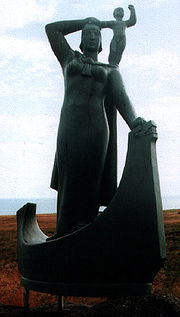
Unlike other Christian characters in the two sagas, who convert to Christianity after living to middle age as heathens, Gudrid grew up in the new faith although her mother, Hallveig, seems to have been a late-in-life baptism. Gudrid figures so centrally in both narratives that they can seem a bit misnamed. Gudrid stands in great contrast to Freydis, Eric the Red's homicidal daughter, who persuades Finnbogi and Helgi to accompany her for a season to Vinland, nags them into heroic productivity, then kills both of them and their entire ship's crew so that she and her piratical henchmen can cash in the proceeds by themselves.
I noted earlier that in Gudrid's day the Icelanders were entertaining the epochal choice between their ancestral dispensation and the new Christian one, and that the limitations of warrior excellence as a way of life were becoming apparent. In this light it is worth mentioning that The Greenlanders' Saga and Erik's Saga both seem favorably disposed to the new mercantile ethos of labor and trade. They advocate it rather than reporting it neutrally. The saga-writers see in Erik the Red many admirable qualities, but they also judge that he belongs to the old generation, whose day has passed. Indeed, the sagas report of him that his life consisted in constant relocation because his habits of taking offense and fomenting conflict with his neighbors continually got him outlawed by the local assembly.
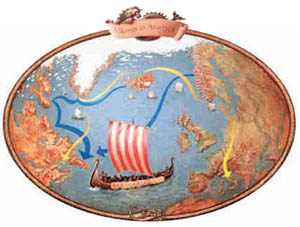
As for Gudrid, when a young woman, she lived as foster-daughter in the household of Orm of Arnastapi, at first in Iceland and later in Greenland. At first, in Greenland, Orm's kin dwelt in a house, with others who had also emigrated, at the farmstead of Thorkel of Herjolfsness. During a winter of famine in Greenland, many visitors sought aid from Thorkel, who owned considerable stored-up goods; among these came visiting an itinerant "prophetess" named Thorbjorg, whom people called "the little Sybil." She told fortunes in exchange for meals, gifts, and one or two nights lodging. With many guests in attendance, eager to know their futures, Thorbjorg proposed to sit in state and read the signs for her petitioners, but she needed an assistant to sing the appropriate "Warlock Songs."
As it happened, only Gudrid knew these songs – knew them well because she had learned them from her foster-mother Halldis, a minor seeress in her own right, now dead. Yet when Thorbjorg put her request, Gudrid at first refused, saying it stood at odds with her Christian faith. One can understand Gudrid's initial balking. As Christianity was still new in Iceland, the adherents of the faith would likely have felt somewhat keenly its tentativeness in the community. They would have sought to protect it from compromise, perhaps too zealously. Thorbjorg then said to Gudrid, "It may well be that you could be help to others over this." Thorkel pleaded with Gudrid, who honored him by relenting. Erik's Saga says that she "sang the songs so well and beautifully that those present were sure they had never heard lovelier singing," and the Sybil "thanked her for the song."
On consideration, as readers of the saga may legitimately infer, Gudrid must have judged at last that no severe conflict prevented her, a Christian, from singing the heathen runes. No harm would come from it but, on the contrary, some good might. Her refusal to lend her excellence in service would constitute, by contrast, a needless offense against Thorkel's hospitality and it would lead to disappointment on the part of hopeful guests who were looking for bright news in bad times. Moreover, given the description of Gudrid's performance in the saga, it seems that Gudrid appreciated this lore and had invested some considerable energy in learning it and practicing it.
Furthermore, the performance of the prophetic rites has the nature of a transaction. It belongs therefore to the new dispensation of commerce. The prophetess loots nothing, but offers a service whose psychological benefit in harsh days is obvious and whose purchase by the buyers is justified on those grounds. Gudrid's compromise entails no stain on her Christian conscience, after all, and accords to the songs their object merit as instances of artistic beauty.
This custodial attitude towards the heathen traditions typifies the coming of Christianity in the North. A few generations after Gudrid, when Iceland was thoroughly Christianized, an attitude similar to hers would characterize the efflorescence of West-Norse literacy, of antiquarianism and scholarship, that had its unlikely loci in various farmsteads and churches all across the island and that produced the body of saga-literature. The literacy of the thirteenth-century Icelanders is an amazing phenomenon. It produced a body of narrative and commentary equal to anything produced in the same period of time in continental Europe.
Take the case of Snorri Sturluson. Snorri was a Catholic priest who dwelt at Oddi, another northern farmstead. While overseeing a community of religious, Snorri collected the old stories of the gods and put them in scholarly and literary form in his Edda. Snorri clearly loves the old tales and finds a way to link them to the Gospel. The Aesir (Odin, Thor, Frey, and the others) were sub-gods, perhaps princes fleeing from Troy, who, at their most noble, felt the tug of the "All Father," who is the same as the Father of the Gospels.
But the real exemplar is Gudrid. Truth is for Gudrid not a doctrine, at least not a rigid doctrine from the stiff posture of which one may never relent. I believe that Thorbjorg is an exemplar, too, for she says to Gudrid that she will not press her, but will leave matters to Thorkel. The intention not to provoke a confrontation is moving. Erik's Saga records a brief but telling rencontre of two chivalrous women.
Photo Finish
Submitted by Atlanticist911 on Thu, 2009-02-26 20:48.
'
@ Capo
Yes, I know.
(Tell me) WATTS Going On***
Submitted by Atlanticist911 on Thu, 2009-02-26 20:12.
@ Capo'
In the spirit of the new 'Special Relationship', if 'you' are going to choose O'Bama, it's only appropriate that 'we' choose George Frederic Watts.
http://www.telegraph.co.uk/culture/art/3563194/Barack-Obama%27s-favourite-painting.html
*** See: Marvin Gaye lyrics.
O'Henry!!!
Submitted by Capodistrias on Thu, 2009-02-26 20:35.
I have that print on my wall right in front of me under my print of Capodistrias. I found it in my mother's house this new year tucked away in a closet. WATTS going on is right, you Brits got cameras everywhere!
Oh! Mr Porter (what shall I / We do?)***
Submitted by Atlanticist911 on Thu, 2009-02-26 19:11.
@ Capo'
An interesting choice. And what would your choice be for a US based version of the fourth plinth I wonder. (DON'T say Bob Dylan!...). O. Henry perhaps? Famous for writing stories with surprising endings. I'll leave you to ponder on that one.
*** http://www.musicsmiles.com/oh_mr_porter!.htm
And O. Henry's real name was...
;-)
The Fourth US Plinth?
Submitted by Capodistrias on Thu, 2009-02-26 19:37.
O'Bama
Oh! Mr. Porter what shall I/We do?
The Fourth Turning ( liberal # 3)
Submitted by Atlanticist911 on Thu, 2009-02-26 15:49.
http://www.bullnotbull.com/archive/fourth-turning.html
I believe the aforementioned article offers both the liberal and the conservative much food for thought, prompting me to consider four 'turnings' of my own, with the jury still out on who or what should be the permanent feature on display at turn four.
* The Fourth Commandment
* The Fourth Estate
* The Fourth Protocol
* The Fourth Plinth www.fourthplinth.co.uk
@Atlanticist - Charles IV?
Submitted by Capodistrias on Thu, 2009-02-26 18:13.
The Fourth Blinth? "Charles IV" i.e. the current Bonnie Prince Charlie.
Given the scuplture's guidelines, I guess it would be a monument to 'Representative Monarchy' and the sun finally setting on the British Empire.
a liberal # 2
Submitted by marcfrans on Wed, 2009-02-25 19:57.
@ pvdh
You made a commendable effort, and it deserves a response.
1) It is important to separate ideas from observable reality (which is NOT to say that 'ideas' are not part of 'reality', just not physically observable). On the level of ideas, one has much latitude in defining terms like "liberalism" and "conservativism"; they could mean almost anything, or their meaning will subjectively vary much depending on the person making the 'judgment'. By contrast, on the level of observable reality we are dealing with concrete people and 'movements' or groups who may be ACTUALLY behaving quite differently from what you are imagining on the level of ideas. In short, the 'labels' in the empirically observable world often do NOT accord with the labels from the 'idealised' world. For instance, it seems rather naive, and selfserving on your part, to claim that liberals are supposed to believe in "scientific findings" and conservatives are supposed to be followers of "dogmas". That may be your arbitrary (and I would say rather naive) definition of those terms, but it is a definition which certainly does NOT accord with what one can observe in the real world of people and 'movements'. It is manifestly nonsense to claim that "there is no 'just so' for a liberal..." when one translates the world "liberal" (in its 'American' usage) broadly by the political left in either the US or Europe today. I think that the best proof of that lies in the empirically observable fact that virtually all recent attempts at suppression of 'free speech' (and or opinion) come from the political left. Although I must add that, on this presumed conservative website, there are several clear examples of both authors and commentators who have revealed similar tendencies of 'intolerance'.
2) Yes, of course, sensible people will recognise that there will always be "gradations" to be found among CONCRETE individuals, irrespective of whether they are properly considered liberals or conservatives. But, I would replace your rather 'dogmatic' and prejudiced definitions (of both liberalism and conservatism) by other definitions that are more based on empirical observations (and less on dogmatic ideas and/or 'ideals'). So, I think that "conservatives" tend to be more sceptical and cautious about human nature than "liberals". They tend to cling more to time-tested values and behavior patterns, as opposed to the more 'everything goes attitude' of liberals. There is some truth in the old saying that a conservative is a liberal-who-has-been-mugged-by-reality. Obviously, that understanding of reality (i.e. of deleterious consequences of abandoning time-tested values or behavior patterns) comes faster for some than for others. Indeed, some never seem to learn from observable facts, and others seem to have been born 'wise' (before their years).
3) Indeed, "tolerance" is a moral virtue. But it ceases to be so, if it degenerates into moral relativism, i.e. into a refusal to make moral judgements or into "respect" for ANY (or ALL) "points of view". The latter would only reveal either a lack of willpower (a 'normative' moral failing) or a lack of intellectual discrimination (a 'positive' failing at the level of knowledge and/or of 'common sense').
a liberal
Submitted by peter vanderheyden on Wed, 2009-02-25 11:59.
Let me first state that the piece above is extremely beautifully written; though I needed to lookup a translation for about 10% of the words. Nevertheless, having been depicted a liberal quite often on this website, allow me to write some comments, often in defense of liberals in general.
If conservatism is not a doctrine on itself, its goal is often to “conserve” existing doctrines whether they are Christian, political or –in general- anthropological. Conservatives often use “commonsense” rather then dogma’s as the proof for their propositions, but it’s exactly “commonsense” that is derivate from what has been generally –and often dogmatically- thought until now. That leads to a circular reference. To me, trying to keep out of this circle is exactly what defines “liberalism”. A liberal is in no way dogmatically against generally accepted believes and habits, but rather will always test them on their soundness in the light of new, often scientific findings. In fact there is no “Just so” for a liberal..
I like the way the author tries to depict liberals as harsh and loud in contrast with conservatives who our supposed to be restrained and thoughtful, but even he will recognize the caricature he has made of it. In conservatism as in liberalism there is certainly some gradation to be found.
Finally we could see the Icelandic sagas as an encounter between liberalism and conservatism. Indeed, the introduction of Christianity in a pagan world is an act of liberalism. The old truths are clearly put into question, and are replaced by new ones based on teachings coming from outside the community. As a matter of fact, these sagas contain a message for both conservatives and liberals. The message of tolerance and respect for our different points of view.
@KO
Submitted by Takuan Seiyo on Wed, 2009-02-25 01:51.
Indeed, it's nice to get such a morsel as Prof. Bertonneau's "Gudrid" without having even known, as is the case with me, that it exists. You are a presaging an idea that I hinted at in the Amaterasu essays bu have not fully developed. It will be at the end of the Meccania series and I've anticipated much resistance to it, particularly from you and other traditional Catholics. In brief, I see a great imbalance in modern Christianity. The ideas that came from Jesus and the Apostles, based on love, redemption, forgiveness and the Jewish precepts of law, justice and social justice, dominion over Nature, eschatology, have taken over the faith. This has caused what I call a yin imbalance, leading to meekness, obsession with peace to the extent of shunning righteous and necessary war, obsession with equality at the expense of freedom, disregard for the sovereignty and holiness of Nature etc. All these missing precepts may be found between Europe's animism-pagan past, the Greeks and the Romans. I am particularly interested in the Nature connectedness of these proto-Europeans.
A response to Seiyo's idea of imbalance in modern Christendom
Submitted by Rembrandt on Wed, 2009-02-25 13:29.
This meekness and passivism you speak of is, I believe, more a product of 70 years of intense liberalization of society than it is of Christian thought. Appeasement is, after all, the essence of liberalism. The tendency to reward the bully and punish the victim is visible in ALL aspects of society throughout the Western world. Rush Limbaugh, our famous conservative commentator, calls it "the feminization of America."
This is an interesting line of thought, but more in line I believe when considering the nature of American rather than European Christianity.
I could be mistaken, but I have come to believe Christianity is all but dead in Europe, based on what I have read considering church attendance there. "Imbalance" is an understatement; I don't think the faith exists except as a vestige of history and culture.
In America, Mr. Seiyo's supposition has much more weight. Protestant Christianity doesn't lend itself to group mobilization nearly as well as either liberalism or Islam with their GROUPTHINK mentalities. Moreover, conservative Americans are VERY MUCH law and order types. We cling doggedly to the "passe" truth that good will prevail, despite growing evidence to the contrary that we have lost control of the government.
This imbalanced passivist view is VERY MUCH the mainstream of thought for our American Christian spectrum. Which is peculiar for a people group that greatly emphasizes patriotism and the role of providence in the Revolutionary War.
It also makes me marvel at leftists, who portray Christians as "rabid theocrats" who want to impose religions dictatorship on America while being COMPLETELY UNCONCERNED with Islam's insurgency against the West. I tell you, if I wrote a science fiction novel about the world today, I would never write it the way it is happening in reality. It would sound too farfetched.
On the other hand, American Christians exert much effort in the cultural war. They are quite involved in Christian education and Christian mentoring of their children. And it is successful by and large, because private Christian schools in America are superior to the public schools in every regard - as long as they do not allow TOO MUCH of the taint of the public schools to creep in via contaminating sources. American Christian schools emphasize academics and the pursuit of excellence and rational logic. They are the ONLY REAL flame of conservative resistance in the country today, against the overwhelming tide of opposing liberal ideologies sweeping the country. More influential, I dare say, than EVEN THE CHURCH itself.
I do wonder, however, if Christians and Americans in general will be aroused at all as in the future, the government begins to exert more and more effort to indoctrinate children in the communista fashion. It is an agenda of the liberals in America to control what children are taught and to diminish the role of both parents and religion in rearing them.
One last note: There is no concept of "holiness" of nature in Christianity. Man is a steward of the Earth; the Earth is a blessing from God. But, only God is holy, being defined as "seperated" and set apart to perfection.
@Rembrandt
Submitted by Takuan Seiyo on Wed, 2009-02-25 19:21.
Re: Man is a steward of the Earth; the Earth is a blessing from God.
Precisely so. But it's only because it's a precept we have inherited directly from the ancient Hebrews. It was what the spirit of the times called for when the Hebrews entered Canaan 3500 years ago. It's because all the surrounding peoples worshipped deities representing various forces of nature that they practiced human sacrifice an other such things that were an abomination for the monotheist Hebrews. The Hebrews therefere placed God outside and above Nature, and man as a ruler of Nature in loco parentis. It helped that their was a shepherd and not a farmer culture.
I believe we have gone way too far in this directions, and no longer by necessity. That's why atheists and screaming Green psychos have taken up the defense of animals and forests, while "conservatives," don't mind if their dividend check comes from a strip-mining company nor want to know the details whereby living, sentient creatures become their rare beefsteak. But the land where you were born, its trees and animals and everything in it are not just a larder created to satisfy man's greed or gluttony. Ancient Hebrew shepherds are not the only prototype suitable for our interior furnishing.
I believe that examining the pre-Christian traditions of the cold zones of Europe can yield insights into how to relate to the land and what creation of Nature remains on it. Such an insight, including its holiness aspect, is as compatible with Christianity as the Christmans tree and decorated Easter eggs. And I believe that it can go a long way not only toward restoring a greater measure of spirituality to Christianity but also toward wresting a key political issue from the Left, moreover, an issue that the young care very much about.
Stewardship
Submitted by KO on Thu, 2009-02-26 00:46.
Virgil's Georgics are a beautiful inventory of the human order within the divinely organized natural order. They were much studied in early medieval Europe. They examplify the West, pagan and Christian, making a home in the natural world, not consuming it. Another text for Prof. Bertonneau's series, one hopes.
Icelandic sagas
Submitted by KO on Wed, 2009-02-25 13:09.
Mr. Seiyo: Yes, here is more testimony to the excellence of the Icelandic sagas, with a true scholar's insight into their spiritual core: Christian charity towards the pagan past of one's people. In a related vein, Tolkien's great essay on Beowulf notes a deep pathos on the part of the Anglo-Saxon poet for the pagan ancestors damned by their ignorance of Christ.
I agree there is an imbalance in most forms of contemporary Christianity known to me, which is why I look to the early medieval period for examples of Christianity engaged with life and death struggle. A king like Alfred, who translates fundamental Christian philosophical and historical texts for an embattled civilization, provides for the fortification and garrisoning of towns, defeats and forcibly converts pagan invaders, mandates literacy for his officials, and reforms the coinage is an outstanding Christian, one who can serve as a signal fire for those who seek the renewal of the West. The Polish knights in With Fire and Sword and The Teutonic Knights also exemplify Christianity in its true, non-liberalized form. Modern liberalism values harmony over freedom. The harmony sought is simply non-suffering, a hedonistic and base version of nirvana. Nietzsche identified it in his vision of the last man in Zarathustra. I think the diagnosis of yin imbalance is accurate, with the suppression of male authority and virtue in all spheres and the devaluation of transcendent truth. It is easy to go astray in this area. The Islamic world, in my view, is the most yin poisoned of all, with the brittle hyper-masculinity of the jihadist being a product of such poisoning (cf. Baron Charlus in Proust). The harem in fact determines the nature of Islamic masculinity. By the same token, the cult of Mary can be a sign of perfected manliness (again, Sienkiewicz's Polish knights). The West at its best exemplifies balance. Neither Christianity nor the West does so now. Prof. Bertonneau's essays on Bach, Epicurus and the Icelandic saga aim at restoration.
(PS. It is of no significance, but since you address me as being a traditional Catholic, I must reluctantly disclaim the honor, and admit to being a conservative Episcopalian whose theology has been supplemented by Robert Cohn's polypolarity and Eric Gans's Generative Anthropology.)
Conservative Christians
Submitted by KO on Wed, 2009-02-25 01:21.
Thank you for this extremely interesting article, Mr. Bertonneau. You depict a variety of Christian stewardship that regards even pagan culture as worthy of respect and preservation. It seems to be a reflection of your essay on Epicurus, in which you, the modern, possibly Christian Westerner, take an affectionate and respectful survey of certain of our philosophical ancestors. Now, this kindliness is necessarily selective. Neither Gudrid, nor Snorri, nor you defends every aspect of paganism, but rather cherish only its achievements, not its horrors. You also do not make a place for a paganism that seeks to dominate its past rivals. I wonder if you are attempting to delineate the West in its broadest outlines, somewhat in parallel with Mr. Seiyo's essays on the current state, and the future, of the West.
I wonder if your essays will also delineate what the West is not. That is, there is also much to cherish in Islamic culture and the virtues of Islamic peoples, but that doesn't mean one doesn't regard Islam as inimical to the West and wholly incompatible with it. One can take a kindly, charitable, admiring view of our fellow humans who are Moslems, and still regard Islam as a hostile political movement, whose adherents should be rigorously prevented from immigrating to the West, where no Moslem organization should be permitted. Gudrid could have admired Saracenic virtues, at the same time as knowing that Saracenic enemies should not be permitted to settle, and multiply, in Iceland.