
The Dangerous Return of Utopian Socialism
From the desk of Martin De Vlieghere on Thu, 2009-10-22 16:17
Jeffrey Sachs is senior economist at the UN and author of the bestseller "Common Wealth" and the controversial Time essay "The Case for Bigger Government". In a recent interview in the Brussels newspaper De Tijd Jeffrey Sachs blames “unbridled American market capitalism” for the financial crisis and pleads in favor of the Swedish social model as an alternative. His ideological argument is revealing for the dominant utopian-socialist mind at the top of the UN.
The Swedish social model, which Sachs would like to introduce, has not the only the largest Size of Government of Western World, but also the weakest economic performance of the OECD. In 1970, Sweden still was the fourth wealthiest nation in the world. Thirty years later, Sweden had fallen to rank 17 with catastrophic social consequences. In the meantime the U.S. consistently managed to remain the second or third for more than half a century. So there is not much socio-economic wisdom to be learned from the Swedish Social Model.
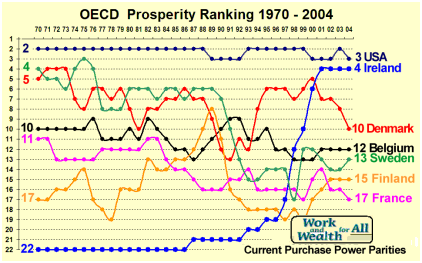
Sachs also argues that "unbridled capitalism" is the cause of the current crisis. The reality is that during the last twenty years central planning progressively intruded Western economies who now bear the burden of governments spending 40% to 55% of GDP. Entrepreneurs face ever more crippling restrictions, licensing schemes, quotas and price and quality controls. Businessmen endure tens of thousands of pages of new rules and regulations each year, all written in a lawyers slangy that totally undermines the legal certainty of the free market and which transformed business into a gamble on the next political caprice and on judicial interpretations of the legal jargon. Size of government, computerized control and dirigisme has now reached a level plan economists of the Soviet Union could only dream of. Not the capitalistic system failed, but excessive dirigisme is to blame for the crisis.
Monetary Policy
Sachs also fails to mention the role of monetary policy in the financial crisis. Still it was money printing that undermined our purchasing power, and heavily forged our means of exchange and saving, with massive distortions as a result. The reason why interest rate manipulation causes so much distortion is that the interest rates are the key factor in all spending and investment decisions. Not only in the choice between saving and consumption, but also in the investment calculus between capital intensive and labor-intensive production processes. Years of low interest rates lead to overinvestment in futuristic automation and nonsensical expulsion of low-skilled labor from production processes. The colossal waste of low skilled labor tumbles overall productivity resulting in lasting stagflation and heavily suboptimal living standards.
Way too easy access to cheap credit also lead to the banks’ under-capitalization and extreme leverage ratios, and to a massive competitive disadvantage of labor-intensive SMEs in favor of big business. System Threatening concentration and monopolies are the result. Industrial overproduction and huge inefficiencies due to shortages of service providers are just a couple of the actual symptoms.
New Monetary system
Technological and commercial progress result in yearly productivity gains of 2 to 3%. Prices should therefore fall by 2 to 3% and not rise as we now witness for as long as one remembers. The positive inflation targets adopted by Central Banks worldwide seize all the benefits of progress in favor of the bankers, and systematically confiscate 4 to 6% of Joe Sixpack’s and Sally Housewife’s added value. Such inflation leads to severe distortions and is fundamentally unjust. The collective achievement of progress belongs to the whole of society, and in the first place to those who most contribute to it. Worse still is the fact that inflation devalues worker’s savings so much that the real purchasing power is often only one third when they reach retirement.
We do not need a Swedish social model as Sachs argues, but an just monetary system. Such system can only be equitable and achieve efficient allocation of resources when monetary growth is zero or at the most limited to the growth of the real economy. A return to the gold standard may be the best guarantee thereto.
Kyoto and Emission rights
Sachs also belongs to the side of the climate fixers who take the controversy over the global warming trend for a "global consensus" and continue to believe that human action caused the trend and may even reverse it. According to Sachs Southern Europe will soon dry out and cause a massive flow of refugees to the north. The bombastic climate alarmism in the run up to the Copenhagen Climate Conference next month must be understood as an ultimate attempt to convince conference goers to step into the global emissions bureaucracy.
CO2 Emission rights are a totally fictitious but legally indispensable commodity for most production processes. Politics will determine its degree of scarcity and the regional allocation, thereby disconnecting production costs from market reality and cause massive distortions. The global ETS scheme is not only fraud sensitive. Scarcity and allocation being the result of political decisions, inside knowledge are likely turn the ETS scheme into one big swindle with grave counter-productive effects. The Soviet debacle learned to what systemic waste the falsification of competition and the elimination of market forces can lead. High subsidies for extremely low productive windmills and solar panels in the Western World for example are causing awfully suboptimal use of scarce resources worldwide. Under free market conditions much more productive use would be found in developing countries.
Market oriented Alternative
Before attacking hypothetical problems, let us first solve the real problems that threaten humanity. One single water pump at an equivalent cost of a couple of solar panels can indeed spare hundreds of Sahel women the daily journey to the spring and spare many infections and lives.
Fundamentally, Kyoto emission rights are nothing less than a World Tax on existential human needs and are therefore incompatible with the human right to development. The scheme will cost the Belgian taxpayers 3 to 5 billion Euro annually in the first phase, or the equivalent waste of a "Long Wapper" each year. And such type of taxes tend to increase over time.
If indeed CO2 reductions ever proved to be effective in the “climate management”, national governments can just as well raise existing taxes on fossil fuels without the extravagance of the global emissions bureaucracy. As consumers will only substantially save energy when energy becomes expensive, it is the only effective and market-oriented way to reduce emissions without the distorting political interference. The administrative cost of such an increase is zero whereas a shift of the tax burden from income to consumption can only boost the economy rather than destroying it as would be the case with emission rights.
The emission rights scheme and the World Climate Organization which Sachs calls for are dangerous steps towards a "New World Order" that bring closer the specter of a World Government under UN tyranny.
Sachs calls it frightening that the fate of the world depends on what (democratically elected national) senators think about global warming. Even more frightening is to entrust our way of life and our living standard to the utopian socialist ideals of a few UN despots who escape democratic control. Even Marx saw in the Bourgeois idealism of utopian socialists the biggest threat of all to mankind.
This article was written by philosopher Martin De Vlieghere and businessman Paul Vreymans
RE: Fincioen 7 (the final instalment)
Submitted by Kapitein Andre on Thu, 2009-10-29 01:06.
Marc Frans,
More of the same, except you’ve added clichés to the mix. I won’t engage with you further on this article until you’re prepared to engage the issues and facts at hand.
I’d defy you to post more fluff, but you’d probably take me up on that offer.
Ball’s in your court buckwheat ;)
Ciao,
Capitão
Fincioen # 6
Submitted by marcfrans on Wed, 2009-10-28 03:58.
@ KA
Words are cheap, and accusations are plenty. I defy you to specify one specific point that I have "denied"?
RE: Fincioen 5
Submitted by Kapitein Andre on Wed, 2009-10-28 01:59.
Marc Frans,
It is now quite obvious that neither you (nor Mr Fincioen) are prepared to fully and honestly debate healthcare in the United States. I have never associated you with evasiveness until now, and it is unfortunate. Your attempts to engage with me, rather that with the facts, are an ideological smokescreen worthy of atheling or a spy – “deny, deny, deny, make counter–accusations.”
Fincioen # 4
Submitted by marcfrans on Tue, 2009-10-27 17:39.
@ KA
There was nothing "disingenuous" about my previous posting - or at least you have not identified anything "disingenous" in it - whereas you are setting up a strawman. I certainly am not going to question that Taiwan's 'great' health care system could be improved upon.
I am amused, though, by your 'certainty' that Taiwan's system would be "the most efficient". How on earth can you be so sure of that? Because it appears in some table issued by an international organisation? That reveals a naivete that is unbecoming for someone as smart as you. Health care is one of the most interfered-with sectors in most economies. Measurement of its presumed 'efficiency' is therefore unavoidably going to be tentative - and often worse - highly 'ideological'. If the US health care system is "inefficient" - and it likely is to a very high degree - the main reason is because many disparate health care decisions (both on the demand side and the supply side) are very much divorced from actual 'market conditions'. "Efficiency" concepts, divorced from free markets, are like pornography and beauty, i.e. in the eye of the beholder.
RE: Fincioen 3
Submitted by Kapitein Andre on Tue, 2009-10-27 02:26.
Your response is disingenuous. Even the most efficient national healthcare system, that of Taiwan, could be improved upon. Moreover, we are not discussing "many other" alternatives to the current US system, but rather those used by other advanced industrialized economies, of which there are few.
I agree with your points on the current offerings, albeit ones shaped as much by HMO and insurance lobbyists as by universal coverage advocates. Please clarify the rest, and what you mean by "proper criteria".
Fincioen # 2
Submitted by marcfrans on Mon, 2009-10-26 23:56.
@ KA
You are not going to get an argument from me that the American health care system is underperforming in some respects, but I do claim that it is performing better for many Americans - perhaps most - than many other "systems" would. The issue is not that some reforms could lead to improvement. The issue is whether what is currently on offer would be an improvement. Health care 'outcomes' do NOT SOLELY reflect the "health care system", but many other factors as well.
When one takes a given situation as a starting point, then one can make matters better OR worse. And to make that judgment one first has to agree on proper criteria.
RE: Fincioen
Submitted by Kapitein Andre on Mon, 2009-10-26 21:18.
Marc Frans,
Fairly recently it was commonplace for Europeans to be at least conversant in several other languages. Although some can speak a little French, most young Germans are limited to German and are about as fluent as the French in English, which is not complimentary.
Back to the article, I don’t know what Mr Fincioen’s qualifications are outside of blogging on Belgian beers. The article is disjointed, lacks a direction or overall thesis, and is far too short to make a meaningful contribution to the American healthcare debate. It is telling that “death panels” and inaccurate references to clinics and hospitals admitting uninsured patients receive more attention than the comparison of healthcare among Western industrialized economies. If Mr Fincioen is noting that entrenched interests and the American public’s aversion to higher taxes will make Obama’s cure worse than the disease, he is on point.
The facts tell three stories: firstly, that the current American system is the most expensive, non universal and a consistent under-performer; secondly, that the United States has the lowest share of healthcare costs paid by the government, without decreasing the share of revenue devoted to healthcare; and thirdly, that not all universally-insured healthcare systems are identical, as the marked difference between Japan and the UK illustrates. This latter story brings to mind the benefits of preventive healthcare via diet and nutrition…
I draw your attention to research by the Commonwealth Fund and the OECD. 2009 OECD updates are here.
Ciao.
Capitão
Fioen
Submitted by marcfrans on Mon, 2009-10-26 16:40.
KA
On this webpage, under the titel 'The Brussels Journal', you will see a blue-colored 'band' with five 'buttons' (Home, English, Notable& Quotable, Nederlands, Contact, and About).
If you click on the button 'Nederlands' you will see the article by Mr Fioen. It should be 'fun' for a German to read this text in another West-Germanic language. Some of the Dutch word constructs can be long too, but none reach the ridiculous length of the German "Einfachungsbestrebungen" (For nonGermans that means "efforts to simplify").
P.S. Any possible references (in my Dutch-language commentary) to "den Belgique", are not in proper Dutch, but rather are reflective of 'Flemish sarcasm'.
To Marc Frans RE: Equality vs. Progress
Submitted by Kapitein Andre on Mon, 2009-10-26 00:20.
General agreement on all your points. Unable to locate the article by Mr Fioen.
Disagreement with European media having a captive audience. Der Speigel has had many well-researched articles on healthcare with analysis far superior to that featured in American media.
The trouble with central planning
Submitted by rpwins on Sat, 2009-10-24 10:19.
is its inability to deliver on its promise.Sachs also forgets to mention the fact that free market main street capitalism (if there ever was one) was methodically, with each successive government, hijacked from the people, and creepily morphed into plutocracy for the benefit of the few at the expense of the many.The hemorrhaging government bureaucracy has provided a perfect cover for kleptocrats and their corporate cronies waving the banner of public good while stealing the fruits of their labor.
Sachs # 3
Submitted by marcfrans on Fri, 2009-10-23 22:44.
@ KA
1) Naturally, all national income accounts variables (and stats about them) have their limitations, like any other human constructs. However, they do attempt to measure objectively what is measurable (reflecting consumer preferences via market valuations, although GDP includes certain 'imputed' components). GDP does NOT "reflect wealth expansion or consumption". First, because consumption is only a component of GDP, and, secondly, because GDP is a flow concept, i.e. it measures total output/income/expenditures in a particular economy in a given time period (a year). By contrast, "wealth" is a stock concept, i.e. it measures all available valuable assets at a given moment in time, and is of course linked to the past in a complicated way via past investments (and is much harder to measure than GDP is).
2) There is nothing wrong with looking at other measures of 'wellbeing', as long as one is aware of what one is comparing and often of the subjective (often political/ideological) nature of these measures. I agree with 'p v' that empirical research (time series and cross section) confirms that the relationship between 'equality' and economic growth follows an inverted u-shape, which suggests that extremes in both income distribution and in wealth distribution should be avoided. Personally I am more concerned about uneven wealth distribution than about uneven income distribution, because I expect the latter to be more closely linked to individual differences in 'effort', while the former is likely to be more reflective of differences in 'circumstances'. I also hazard to guess that, in open and free societies, income inequalities can actually contribute over time in promoting a 'better' wealth distribution (not necessarily in the sense of reducing wealth inequalities, but rather in terms of changing wealth ownership around over time). This, in contrast with less-open and less-free societies, where I expect the reverse, i.e. that the existing wealth distribution will largely determine the income distribution (which is likely to be detrimental to economic growth as measured by GDP per capita for society as a whole, once a certain 'minumum level' of average wealth and/or average income has been reached).
3) Regarding health care, I wish to draw your attention to the Dutch language section of this website ("Nederlands") which currently features an article by Johhny Fioen. It contains an excellent summary of major relevant issues concerning the current health care 'debate' in the USA. You are not going to find such a clear exposition anywhere in the mainstream European media, which is to the detriment of all their 'captive' readers.
P.V. RE: Equality vs. Progress
Submitted by Kapitein Andre on Fri, 2009-10-23 18:36.
Paul,
I included the GC as one of several other indicies that should be considered, and I agree with your thoughts on equality vs. progress.
Your and De Vlieghere's blog is interesting, and I look forward to perusing your articles thoroughly.
Sachs Redux
Submitted by Kapitein Andre on Fri, 2009-10-23 07:00.
RE:
1. GDP per capita (PPP or nominal) as a measurement of economic (much less socio-economic) health has certain limitations, as noted by economists from the left and right including the Austrian school e.g. GDP can reflect wealth expansion or consumption. If one is to objectively compare the United States and European states, one must include the HDI, GPI/ISEW, Gini coefficient, PPR, etc.
2. My observations of Irish guest-workers in Sweden are recent to the past 6 years. Ireland's economic performance was lauded for over a decade, even though Ireland received significant aid from the EU and experienced a real estate bubble that has now burst and torn asunder the Irish banking system.
3. I appreciate your correction. I meant universal public health insurance as is the system in Canada, although Canadian hospitals are mainly public. Obviously, not all public healthcare systems are identical, and the British NHS is far from a shining example.
Sachs # 2
Submitted by marcfrans on Thu, 2009-10-22 20:30.
@ KA
1) Nobody is arguing for "endless GDP growth", Sachs included. The important variable is growth over time in GDP-per-head, and that is independent from whatever is happening to "Western population growth". That is (probably) also what the chart is showing, i.e. a ranking of several OECD countries in terms of a comparison of GDP-per-head (as measured by purchasing power parities, not market exchange rates) relative to the richest one (must be Luxembourg?).
2) The chart shows developments in the ranking over the past 40 years, but is becoming a bit out of date in the sense of not reflecting very recent changes. Your comment about Irish seeking work in Sweden is probably out of date too. But it is true that Ireland is suffering more in the current recession than many others.
3) What do you mean by "public provision" of health care? Most health care, on both sides of the Atlantic, is provided by private caregivers and businesses. You must make a distinction between the actual provision of the services and the financing of the cost of their services. The differences among countries have mainly to do with:
- the degree to which the care-receiver remains (partially) responsible for 'paying' for the services,
- and the degree to which the care-receiver has 'choice' in terms of buying specific services;
All Western countries have a mixed system of health care provision, in the sense that the private sector provides the services but government gets involved in the 'financing' (and some provisioning too). That 'involvement', besides many other factors, will influence the quality of care that different people will get in BOTH directions, making some better off and others worse).
4) We do seem to agree, however, on disagreeing with Sach's take on supranational organisations and climate change, and also on his ridiculous ideological blindness to government failures that helped deepen the current financial crisis.
RE: Sachs
Submitted by Kapitein Andre on Thu, 2009-10-22 18:45.
Swedes were concerned with more than economic performance. Endless GDP growth may be captivating, but is it possible or even necessary when Western population growth is in the negative? Despite Ireland’s high OECD prosperity ranking, many young Irish were seeking employment in Sweden, and not the reverse. I believe wholeheartedly that public provision of healthcare is far superior to private. However, I disagree with many of Sachs’ prescriptions, especially where supranational organizations and climate change are concerned.
Equally frustrating is Sachs’ focus on “unbridled capitalism”, when regulatory failures (e.g. rating agencies), federal monetary policy (i.e. cheap credit) and government intervention (e.g. FHLMC, FNMA, TARP) are clearly the culprits. After creating a colossal moral hazard in the real estate and financial markets, the US government then rescued Wall Street’s investment banks from their deliberately risky ventures. Although in principle, the “loans” to financial institutions make sense, Wall Street is not passing the credit on to consumers and businesses. Rather, they are using government largesse to bolster their cash positions and/or continue to speculate. Where does capitalism come into the picture, when investment bankers are indistinguishable from Federal bureaucrats?