
The Brussels Capitalist Ball 2006
From the desk of Paul Belien on Sat, 2006-02-25 23:36
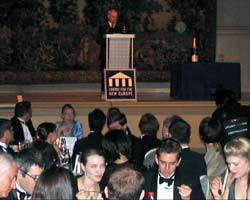
Yesterday evening (and late into the night) freedom loving Europeans gathered in Brussels for the annual “Capitalist Ball” of the Centre for the New Europe (CNE). I founded CNE in 1993. The name was an idea of my wife’s. Lord Harris, who was helpful in finding sponsors, suggested Centre of the New Europe, which could be abbreviated to CoNE, a concept which he liked because it referred to seed. Hence it was slightly reminiscent of the name of the Flemish conservative magazine Nucleus (also suggested by my wife), which I founded in 1990. However, we did not want it to be the Centre of, but the Centre for the New Europe.
CNE was born out of the urge to create a European Heritage Foundation. As a young conservative journalist in Europe (one of the few) in the 1980s I found it bizarre that I always had to travel to the US in order to find, through the contacts of think tanks there, the addresses of likeminded Europeans. In 1993, with the assistance of Fernand Keuleneer, a Brussels lawyer, we began to look for funds to establish our own institute. The Flemish publishing company Roularta and the American pharmaceutical company Pfizer, which has a philosophy of supporting young people with new initiatives through the good care of Catherine Windels (the godmother of all think tanks), generously provided the first donations. Lord Harris of the Institute of Economic Affairs, Lord Rees-Mogg, Digby Anderson of the Social Affairs Unit, and Wilfried Prewo of the Hannover Chamber of Commerce gave invaluable advice.
At the 1994 general meeting of the Mont Pelerin Society in Cannes I was able to present the new think tank. Our first premises were in the Roularta Media Center in Zellik, along the Brussels ring road. The economist Paul Fabra (a Frenchman of Catalan origin) was CNE’s first director. Later Hardy Bouillon (a German, despite his name), Tim Evans (a Brit) and Mattias Bengtsson (a Swede) succeeded him.
Though occasionally I still attend CNE activities, I am no longer formally involved. In a sense the CNE experiment failed. It never became a Heritage Foundation with the seamless combination of both libertarianism and conservatism which is so typical for America and so uncommon for Europe.
Like Americans, I believe very strongly that the free market – and freedom tout court – cannot survive without cultural values rooted in what Americans call “social conservatism” and what Europeans would call “moral conservatism.” In Europe it is possible, though difficult, to find funding for the defence of liberal economic policies, but not if one combines these with moral conservatism. Sponsors willing to support the promotion of freemarket principles are deterred by an organisation that actively promotes social conservatism as well. This is the reason why the Social Affairs Unit, and Civitas, though both had their roots in the Institute of Economic Affairs eventually separated.
That is the major difference between CNE and the American examples – Heritage and the American Enterprise Institute – it was modelled on. While American conservative think tanks walk on two legs, CNE – and the numerous offspring in think tanks throughout Europe (allied in the Stockholm Network, an initiative that also sprouted from CNE) walks on only one. CNE deals with healthcare issues, competition, environmental problems, intellectual property, taxation – all very interesting and worthwhile – but issues which I personally feel are at least equally important, such as education (e.g. the homeschooling movements), the preservation of culture and national identity, the strengthening of families, are outside the CNE’s scope. The reason is very prosaic: there is no money to be found in Europe to address these problems. Worse still, the issues are very divisive among economic liberals in Europe, because they are to a large extent taboo in our secular society.
Four years ago CNE organised its first Capitalist Ball. The 2003 ball was organised in the Beurs, the building of the Brussels stock market, by Rich Miniter (then a Brussels based American). The following three balls would have been impossible without the organizing talent of Cécile Philippe (from France). Last year the venue of the ball moved from the Beurs to the salons of the Concert Noble, which was an improvement. The Beurs building was cold, and for some strange reason, the ball always seems to take place on the coldest day of the year in Brussels.

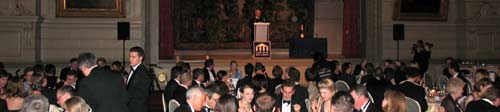
Because, until four years ago, Brussels lacked a classy society event for a multinational European public, the CB was an immediate success. The Economist's Charlemagne column wrote last year:
One of the more bizarre events on the Brussels calendar is the annual capitalist ball, staged by the Centre for the New Europe, a free-market think-tank with an appropriately Rumsfeld-like title.
The event has grown every year. A free dinner precedes a fine ball. Think tank people, scholars, civil servants from the European Commission, journalists, politicians, diplomats and businessmen fly in from all over Europe (and the US) to attend. They do it not just for fun, but because it is a unique networking opportunity. International gatherings, seminars and conferences are now being organised in the days before and the weekend after the CB. Because of the CB’s huge success, many people who would like to attend have to be turned down.
One thing, however, strikes me – and it is again a typically European thing. Last October I attended National Review’s 50th anniversary gala in Washington DC. This was a huge event. Like the CB it was sponsored by major companies. Unlike the CB a list of the sponsors is circulated. Companies do not have to hide the fact that they support the event for fear of negative publicity. In Europe private company donations are regarded as something almost immoral. This applies to both the fact of donating and that of receiving. Europe lives on subsidies, but handing out subsidies is regarded as permissible only if it is done by the state. In Europe the state is god, and hence saying that one believes in another god is a taboo. The state is the sole financial provider, and acknowledging that others have provided for you is a taboo. Companies who are willing to provide for others, especially if the latter are critical of the state, prefer to do this in secret. The state would hold it against them and the companies want to avoid making the state into an enemy. For the state, unlike the true God, is an unforgiving god.
At Markpetens: I agree,
Submitted by Nicolas Raemdonck on Mon, 2006-02-27 23:18.
At Markpetens: I agree, however there has to be a little bit positive law and a judiciary who protects the natural law.
Just a question to mister Beliën: ok, I understand very well your problem and what you fear. However, is it not the problem that we see that a small majority (the muslim fundamentalists) want to try to force us up with their view. Is this not the central problem. So why do you believe a society without religion is doomed. It's a normal question. May be there is already an article about it.
Ah, Mr. Bellen, you don't have a program.
Submitted by Seattle Man on Mon, 2006-02-27 14:24.
"Non-religious cultures cannot survive."
The only problem with such an assertion is that there have too few non-religious cultures in world history -- uh...I can't think of any --on which to base an assertion. And conversely, the record is clear that religious cultures do fail.
So I don't think your assertion is supportable.
As to your "Secularism = Hedonism," that's poppycock. I find it astonishing that a man of your obvious intelligence would believe such an infantile characterization.
And, looking to find a realistic path forward, as if a revival of religion is in the offing. As if a revival of religion would be to the point. The problem is too much religion, of all types, not too little.
Enough said. Good luck to you. God helps those who help themselves. You have much to add in terms of raising the fear level but I don't think much when it comes to a solution.
program
Submitted by markpetens on Mon, 2006-02-27 18:45.
I'd rather have religious natural law than positive law created by legislatures that legislate based on the flavour of the day.
No Mr. Bellen,
Submitted by Seattle Man on Mon, 2006-02-27 00:35.
Perhaps I was not clear. I wrote that I thought that perhaps YOU would like Mr. Pizza Man's program. I personally think he's being silly but I was wondering if it might appeal to you, considering your emphasis on "moral conservatism."
I ask you again: What is your program? You attack secularism as the root of the problem. What is your solution? Rolling back history to the mid-17th century? Countering Islamofascism with your own brand of "vigorous" European nativism? (I am being polite.) A return to the divine right of kngs?
I admire your rousing us to action to face Islamic fundamentalism -- honestly, I do -- but so far the action which you seem to propose is that we should become as fundamentalist and narrow and intolerant as are the Moslems. If I have misread you, I am sorry; but your post on the decline of Europe was pretty clear in its condemnation of "secularism" as THE source of our problems and seemed to urge us to become as limited as our adversaries.
No Mr Seattle Man
Submitted by Paul Belien on Mon, 2006-02-27 08:27.
You seem to equate all religions. The problem is not religion, but secularism because it has created a religious vacuum in the heart of European culture by destroying Europe's Christian roots. The vacuum is now being filled -- as could have been predicted -- by another religion. I am "rousing you to action" because I am a Christian. If I were a hedonist I would flee. As I wrote in the article you referred to: "Nobody fights for the flag of hedonism, not even hedonists themselves." If you ask me to choose between Mr Pizza Man's land and that of Eurabia the choice is obvious. Non-religious Europe is just not an option. Non-religious cultures cannot survive. That is exactly what Europe is proving today.
at Nielsen: I do not see the
Submitted by Nicolas Raemdonck on Mon, 2006-02-27 00:31.
at Nielsen: I do not see the problem. The power of the Pope in the middle ages has nothing to do with catholicism. Freedom in Europe means indeed that people will choose their own destiny and believes. And religion can be one of this believes. And if somebody believes in Catholicism he has also the right to try to persuade on a peacefull way people to take over his own ideas and morals. So that is why a Catholic may and can defend his pro-life views.
But it are islam fundamentalists (not the whole community) who try to indoctrinate us with their believes and do it in a violant way. That can not be accepted.
What I find funny but also a bit sad, is that some people nowadays try to put this aside by saying that you can everywhere find fundamentalism. And then they say some Catholics are fundamentalist. But that is incorrect. Who tries to convince is no fundamentalist but a 'modern' catholic. Who tries to force you to take their religion and values with violence, that are fundamentalist. But I do not see anything about that in Europe or even in the USA.
"Moral conservatism"
Submitted by Seattle Man on Sun, 2006-02-26 18:46.
Mr. Bellen will be happy with this sign:
http://www.timesonline.co.uk/newspaper/0,,176-2058771,00.html
His problem -- and our problem -- is that he believes that we won't be able to combat Islamo-fascism unless we imitate it and we turn back the Enlightenment.
Kind of a tough sell.
In fact, the best weapon we have against Islamic nuttiness is the very secularism Mr. Bellen fears.
Abortion, pornography, contraception
Submitted by Paul Belien on Sun, 2006-02-26 23:48.
You link to an article about an American Catholic who opposes abortion, pornography and contraception. Are these the core values of your Enlightenment and your secularism? No wonder your culture is dying. Your self-inflicted birth dearth will be its doom. It is a pity that these are exactly the issues that CNE does not address, because they are the issues that the future of Europe depends on.
Demcratic values and pluralism should do it
Submitted by Poul Nielsen on Mon, 2006-02-27 00:12.
Different kind of relions - would like to "solve" everybody's problems.
The result is, that many regions standards - don't accept the fact - that people are different and can make their own choises.
During our past history, the pope in Rome, was gathering a lot power. At that town, people was put in to jail, burned, tortured in the name of God.
Now a days - europe, have chosen democracy.
That should solve the issue - if any are attacking the level of freedom in Europe, I don't think,the people in Europe will accept it.
The Capitalist Ball was a
Submitted by Nicolas Raemdonck on Sun, 2006-02-26 15:08.
The Capitalist Ball was a wonderfull event. I wish to thank the organizers of the ball for inviting me.
And it was a pleasure to finally meet mister Beliën personally.
education
Submitted by markpetens on Sun, 2006-02-26 15:06.
If there is one thing classical-liberals and conservatives should agree
on, it is that education ought not to be the business of the state. The homogeneity of public education causes many practical minded students to slack or drop out early, then turning to the streets and cause mayhem there. These students could easily have learned their trade on the workplace, but of course the same state introduces all kind of regulations (minimum wage laws, mandatory employee benefits, unemployment insurance payments, etc.) preventing an employer employing such a youth at a wage according to the youth's productivity (and thus hiring the youth not at all!).
How about a rock concert for
Submitted by Brigands on Sun, 2006-02-26 11:42.
How about a rock concert for the youth? :)