
Information and Disinformation about Belgium
From the desk of Luc Van Braekel on Tue, 2007-11-06 14:27
Today Belgium has been without a government for a record 149 days. On Monday Euronews broadcasted this report (in English) on the Belgian crisis:
Here is the same broadcast in French:
At first sight the report seems fairly balanced. We hear two veteran politicians, one Walloon, Gérard Deprez (a liberal member of the European Parliament), and one Fleming, Mark Eyskens (a former Belgian Prime Minister).
A no-nonsense report without silly allegations about the Flemish Christian-Democrat leader Yves Leterme singing the Marseillaise and with a map of Belgium which correctly indicates not only the Walloon linguistic enclaves of Comines-Komen but also the Flemish one of Voeren-Fourons – something the Belgian meteorological institute fails to do on its own maps.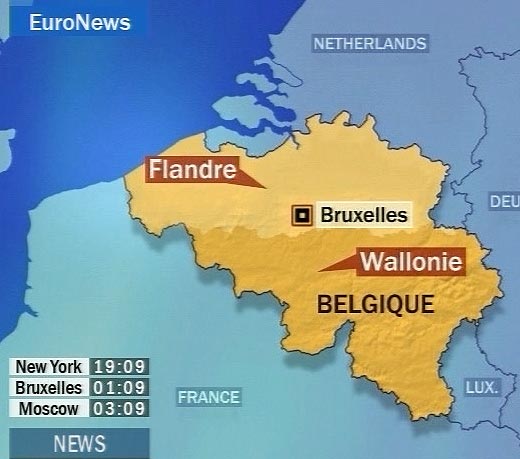
The English version of the Euronews broadcast, however, repeats the often made mistake that Flemings speak another language than Dutch. It mentions “Flemish-speaking” twice, “Dutch-speaking” twice, “French-speaking” three times and “Francophone” once. I can already see an average non-Belgian schoolboy attempting to answer questions based on this broadcast: How many linguistic groups are there in Belgium? The answer: Flemish-speakers, Dutch-speakers, French-speakers and Francophones!
If one listens carefully to what Mr Deprez and Mr Eyskens say, one can only conclude that they are engaged in wishful thinking, that they are saying how things should be in ideal circumstances. They shun away from the real obstacles to the formation of a government and they pontificate about an economic revival and a grand future, perhaps with some minor problems between the communities, parochial problems concerning rural backwaters, some annoying petty villages, like Asterix’s, which should not be taken seriously. Deprez and Eyskens carefully avoid referring to the real problems that are preventing the formation of a Belgian government.
But let us return to the matter of maps. Euronews shows a detailed map of Brussels and its surrounding area. But the map is full of mistakes.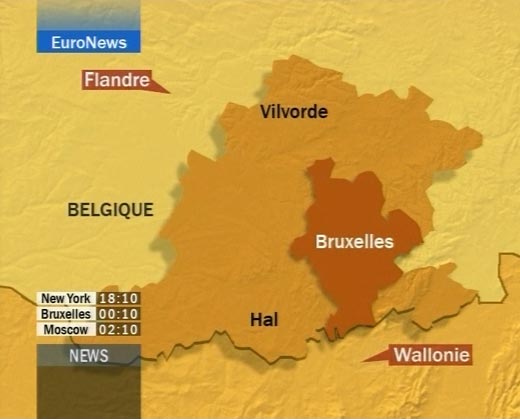
First of all, the six Flemish municipalities with linguistic rights for Francophones have simply been added on to bilingual Brussels. As a result the map indicates that Brussels borders on Wallonia, which is not true. Also, the map does not specify that the Halle-Vilvoorde region is part of Flanders, i.e. Dutch-speaking. The indication “Flandre” refers to the light yellow area, while it should encompass the dark yellow part marked “Vilvorde” and “Hal” as well. Eight different satellites have broadcast this wrong picture across the whole of Europe, the Middle East, North Africa and Central Asia. From the Canary Islands to Pakistan, and from Iceland to Kazakhstan.
And listen to what the broadcast says about the Flemish demand for separating the Flemish region of Halle-Vilvoorde from the electoral district of the bilingual region of Brussels:
It's also a bid to avert a threat by Dutch-speaking parties. They’ve said unless there's more decentralisation, they'll vote on Wednesday to begin the breakup of the electoral district that includes Brussels. Such a move would effectively deprive French-speaking Brussels suburbanites of the right to vote for French-speaking parties.
In French it sounds like this:
Ainsi la menace des partis flamands de voter mercredi la scission de l'arrondissement de Bruxelles-Hal-Vilvorde. Cela priverait 120.000 francophones du droit de voter pour des listes francophones aux élections législatives.
If we translate this, we get:
The Flemish parties threaten to split the electoral constituency of Brussels-Halle-Vilvoorde. This will rob 120,000 French-speakers of the right to vote for Francophone parties in parliamentary elections.
The latter is not true. Even after the split of BHV the French-speaking inhabitants of Flemish Brabant will be able to vote for French-speaking candidates, but only for French-speaking lists presented in their own constituency, and not for French-speaking politicians who are candidates in Brussels (these include some of Belgium’s Francophone political leaders).
But let us not be too harsh for the foreign media, whose correspondents read only Francophone newspapers and who may not yet have seen “Flanders Today”, the new English-language newsletter of the Flemish government.
Let us watch what the Flemish media bring about the Belgian crisis. Last Sunday I watched Royalty, a program on the Flemish commercial television VTM. It had an item about pro-Belgian activists. The journalist Kathy Pauwels said that many people are flying Belgian flags these days. “Especially in Brussels and Wallonia,” she added. Marc Reynebeau, an outspokenly pro-Belgian historian, was allowed to comment that by doing this “the people” want to show that they are worried about the political crisis and hope that the country will remain united. VTM did not say that, though Brussels is full of Belgian flags, there are hardly any Belgian flags to be seen in Flanders. To learn this one had to watch the program Mise Au Point, three weeks ago on the French-speaking public television RTBF, where David Rennie, the Brussels correspondent of The Economist said:
Yesterday I was shocked when I drove to Flanders. I live in Brussels, like many [foreign] journalists. And it is true that we do not know Flanders well. We do not speak Dutch, that is certainly a valid point of criticism. But I was shocked. Like all journalists I had written articles about the appearance of Belgian flags in Brussels. In Flanders there was not a single Belgian flag. Not one. What is more, there was not a single Flemish flag either. That is something. It means that it isn’t civil war yet. [At this moment we see Luc Vandenbrande, a Flemish Christian-Democrat, whom the Walloons consider to be one of the Flemish-secessionist agitators, smile while Viscount Davignon says something to Gérard Deprez]. But we get the impression that the Flemings perceive this crisis differently. This is really telling.
Meanwhile the Belgian papers write that an internet petition in favour of Belgian unity has already been signed by 125,000 people. None of the papers mentions that 80 to 90% of those who signed up are Francophones, as Filip Van Laenen discovered when he examined the language in which those who sign up indicate their nationality. There are so many signatures of French-speaking Belgians that Filip had to draw a second graph in order to be able to indicate the distribution of non-French signatures.
On the current crisis in Belgium, see also:
McKinsey CEO Calls for End of Belgium, Resigns, 13 December 2005
King Warns for Dissolution of Belgium, 1 February 2006
Flanders and France Vote for the Right. But Flanders Will Not Get What It Is Entitled To, 11 June 2007
The Influence of the Immigrant Vote on Belgian Politics, 26 June 2007
EU: The Model is Collapsing. Brussels Calls upon King for Help, 18 August 2007
After Belgium: Will Flanders and the Netherlands Reunite? 23 August 2007
King Summons Unelected Councillors to Solve Crisis. Will France Annex Wallonia? 28 August 2007
Royal Scout Keeps a Low Profile, Brussels Recalls Ambassador in Paris, 31 August 2007
Could Sarkozy Solve Belgium’s Crisis? 3 September 2007
Even Flemish Muslims Want to Separate from the Walloons, 6 September 2007
If Flanders Secedes Wallonia Disintegrates, 9 September 2007
After Belgium: Europe’s New Map, 13 September 2007
Thrembling Thrones in Brussels, 18 September 2007
Save Belgium: Postmodernists to the Rescue, 28 September 2007
Yves Leterme Is Too Soft. Will Flanders Join EFTA? 1 October 2007
Barroso and Bilderberg to the Rescue of Belgium, 7 October 2007
Background articles explaining Belgium:
A City Without Water Is A City Without A Soul, 28 June 2005
How Flanders Helped Shape Freedom in America, 11 July 2005
The Dark Roots of the EU, 5 December 2005
Nations Under Construction: Defining Artificial States, 13 June 2006
Why Is the Vlaams Belang So Popular? 13 February 2007
Belgium, the EU’s Destiny. The End of Nothingness, 25 August 2007
@ spraynasal
Submitted by USAntigoon on Wed, 2007-11-07 13:28.
I will keep saying it: If you want the independence of Flanders, stop
choosing Brussels as your capital, and leave the people around brussels
to choose the state they want to belong to: Flanders or the Brussels
region.
Just make Brussels a "district" like we have in Washington DC...Antwerp might become the capital of the Flanders Republic...
Oh yes you still need to find a solution for the King and his family,...
@ USAntigoon
Submitted by traveller on Thu, 2007-11-08 22:00.
Like I wrote on lvb.net:
After the independence of Flanders without Brussels, let Brussels fester without any financial support and the politicians will come running to Flanders.
Don't forget why the french speaking people from Brussels move to Flanders and the "Rand" around Brussels, because Brussels became unlivable with their crime rate and their muslim ghetto's.
So let it fester and even Europe will leave Brussels, they won't chose to live in "European Casablanca" either.
That's the only valid strategy
To USAntigoon
Submitted by spraynasal on Thu, 2007-11-08 21:06.
I agree with you. The problem is that this district should be a little bigger than the 19 municipalities of present-day Brussels, and that the Flemish nationalists absolutely don't want to talk about this...They keep dreaming of Brussels as part of the Flemish territory.
@spraynasal
Submitted by USAntigoon on Fri, 2007-11-09 00:57.
The Flemish have the right to dream about Flemish Nationalism since 1302, ... However the history showed that they have been exposed and subdued by the typical Belgian/French arrogance. Yesterday they finally voted "en bloc" about the BHV issue.. Now they are mad.. very mad.. they even had to paint "Les Flamands dehors" graffiti on the Flemish Parlement building... So rest assured, the Belgian Kingdom is running on its last legs..
SO the get this all settled for once and forever, make Brussels an "enclave" for all the Europeans to enjoy ..Make the streets wider so that the Eurobus can pass through.. (these are the new very wide buses so that all these fat necks can sit on the front row...)
"spraynasal" I will get you some free tickets for the bus...
@spraynasal
Submitted by Elhaz on Wed, 2007-11-07 11:41.
If we let the inhabitants of some Brussels' municipalities choose they'll probably choose for Morocco or Turkey :)
Like this also Germans living on Mallorca could choose for the island to become part of Germany.
Thanks, Euronews
Submitted by spraynasal on Wed, 2007-11-07 04:34.
I feel vindicated...The six majoritarily french-speaking municipalities around brussels have been added to the brussels territory in the report of Euronews. It's not true, of course, but it's exactly how I would feel the final outcome of a breaking of Belgium: An enlarged multilingual brussels area.
All what I read here about flemish nationalism is stained by this old flemish nationalist dream: To have Brussels back in Flanders. I will keep saying it: If you want the independence of Flanders, stop choosing Brussels as your capital, and leave the people around brussels to choose the state they want to belong to: Flanders or the Brussels region.
@Panduras
Submitted by Monarchist on Tue, 2007-11-06 20:46.
Sometimes I have good laugh when I read article about Poland from foreign media outlets. Different reality. As far as Belgium is concentrated I love to read translation from "Le Soir" newspaper. What a rag! :) They allow Polish radical communist author to write articles about our country.
Cordon Sanitaire
Submitted by USAntigoon on Tue, 2007-11-06 16:41.
You want to see a quick and "democratic" solution to this high stake political chess....Abandon the "cordon sanitaire" and let the VB do what they were elected to do.. Represent the people and participate in government..These other parties are too occupied with the politics surrounding the "existence" of the VB and other previous Flemish Movements..
Euronews
Submitted by Pankukas on Tue, 2007-11-06 15:55.
Can it be considered a reliable, agendaless news source on any topic even remotely controversial or under dispute? My experience with stories regarding Latvia tells - no, and this just reinforces it. Thanks for informative article.