British Schools Drop Holocaust and Crusades

A quote from the Daily Mail, 2 April 2007

Schools are dropping the Holocaust from history lessons to avoid offending Muslim pupils, a Governmentbacked study has revealed.

It found some teachers are reluctant to cover the atrocity for fear of upsetting students whose beliefs include Holocaust denial. There is also resistance to tackling the 11th century Crusades – where Christians fought Muslim armies for control of Jerusalem – because lessons often contradict what is taught in local mosques.

If Only We Had Known

A quote from Jonathan Owen in The Independent, 18 March 2007

In 1997, this newspaper launched a campaign to decriminalise the drug. If only we had known then what we can reveal today...

Record numbers of teenagers are requiring drug treatment as a result of smoking skunk, the highly potent cannabis strain that is 25 times stronger than resin sold a decade ago. […] Professor Colin Blakemore, chief of the Medical Research Council, who backed our original campaign for cannabis to be decriminalised, has also changed his mind. He said: “The link between cannabis and psychosis is quite clear now; it wasn’t 10 years ago.” Many medical specialists agree that the debate has changed. Robin Murray, professor of psychiatry at London's Institute of Psychiatry, estimates that at least 25,000 of the 250,000 schizophrenics in the UK could have avoided the illness if they had not used cannabis.

The B Vocabulary of the EU: Brussels Bans Jihad

The Daily Telegraph has published a story that should concern anybody who believes that by pussyfooting around we will remain in denial about the threats facing Europe and the West,

“The European Union has drawn up guidelines advising government spokesmen to refrain from linking Islam and terrorism in their statements. Brussels officials have confirmed the existence of a classified handbook which offers ‘non-offensive’ phrases to use when announcing anti-terrorist operations or dealing with terrorist attacks. Banned terms are said to include ‘Jihad’, ‘Islamic’ or ‘fundamentalist’.”

Last year, this website already reported about the EU’s attempts to control language and introducing a ‘B vocabulary.’ As Orwell wrote: “The B vocabulary consist[s] of words which [have] been deliberately constructed for political purposes: words, that is to say, which not only [have] in every case a political implication, but [are] intended to impose a desirable mental attitude upon the person using them.”

Gay Atatürk Victim of Belgian “Enlightenment”

A quote from Today’s Zaman, 29 March 2007

Marie Arena, the education minister for Belgium’s French-speaking community in the Walloon region, made a request yesterday for a meeting with Turkey’s ambassador to Belgium in an apparent effort to explain the publishing of a book in which the founder of the Turkish Republic, Mustafa Kemal Atatürk, is listed among the important homosexual and bisexual personalities of history.

[...] “The issue is extremely sensitive, and Belgian officials have eventually noticed their mistake,” Yusuf Seki, press officer of the Turkish Embassy in Brussels, said yesterday, noting that following the embassy's warning, the ministry had decided not to publish in the next edition of the book a list of “Famous homosexuals and bisexuals in history” in which Atatürk was included. [...]

Europe’s Dark Undercurrent

A quote from EU Observer, 21 March 2007

The European Parliament is poised to investigate the legality of draft restrictions against discussion of homosexuality in Polish schools, […] “The disturbing proposals to outlaw discussion of homosexuality raise serious concerns about the commitment to fundamental rights in Poland,” said Dutch green MEP Kathalijne Buitenweg […]. The committee would like the EU parliament’s legal services to probe any Polish bill on two grounds, firstly to see if it is compatible with European anti-discrimination norms and secondly to see if it violates European norms on freedom of expression.

Eurocrat Empire Building

On Sunday, the European Union celebrated its 50th anniversary. The EU was established on March 25, 1957, when its six founding states (Germany, France, Italy, the Netherlands, Belgium and Luxemburg) signed the Treaty of Rome. They solemnly declared that they would aim for "an ever closer union." As a first step towards the goal of political unification the six states decided to integrate their economies. They have meanwhile been joined by 21 other European countries.

Replace the USA?

If you are familiar with this website, you know this author deals with the “transatlantic relationship” and the related “defense of advanced civilizations.” It tells a lot about our time’s challenge that these are not the themes for which his diplomas predestine the writer. For the shift in emphasis, there are good reasons. It is the Atlantic alliance and our Judeo-Christian civilization’s PC defying confidence to rise to its own defense that will determine the future.

Former European Mandarin Exposes Intrigue, Illusions and Dangers

eppink-1.jpg
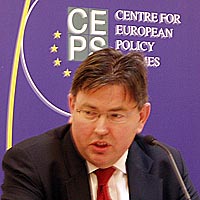
Derk-Jan Eppink

For more than seven years, Dutchman Derk-Jan Eppink worked behind the scenes of the European Commission in Brussels. As a cabinet member of commissioners Frits Bolkestein and Siim Kallas, he saw how what he called "the European mandarins" exercised their power. With the journalistic experience he had gained earlier at newspapers like the Dutch NRC Handelsblad and the Belgian De Standaard, Eppink wrote a book about the EU power culture. Last Wednesday, he and his former boss Frits Bolkestein presented the book at the Centre for European Policy Studies. The Brussels Journal was there and recorded some remarkable comments from both men.

INTRIGUE, TRICKERY AND DECEIT
Eppink tells how he discovered that the essential thing for a European official is to learn the procedures. "Because once you know how the procedures work, you can start to manipulate the process. I arrived in 1984 as a Calvinist, I'm leaving in 2007 as a Jesuit", Eppink said, referring to the differences between the principle-driven approach of the protestant Dutch and the devious conspiracies which are sometimes attributed to the catholic order of the Jesuits.

The Berlin Declaration in Full

So we now have a copy of the text, and it appears that after major league surgery, and despite earlier reports the finished document may well be anodyne enough for the Heads of Government to sign it. However I still have my doubts. The translation is by a friend and thus is not the official final text in English but is close enough.

Declaration for the 50th anniversary of the Treaties of Rome
 
For centuries Europe was an idea, a hope of peace and understanding. This hope is now fulfilled. European unification has made peace and well-being possible for us. It has created a sense of community and overcome obstacles. Every Member has helped to unite Europe and to strengthen democracy and the rule-of-law. We have the love-of-freedom of the peoples of Central and Eastern Europe to thank that today Europe's unnatural partition has at last been superseded. Through European union, we have diverted our counsels from bloody conflicts and painful history. Today, we live together, in a way, which was never possible before.

Bitter Birthday for Europe

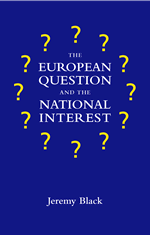
european_question_cover.gif

This is the text of a lecture I gave last October at Cornell University. It is published here on the occasion of the 50th anniversary of the Treaty of Rome (25 March 1957)

In the history of Europe the idea of integrating policies on a pan-European level – in other words the idea of European political integration – is a fairly recent phenomenon. In Europe the word “Europe” has now become almost a synonym of the term European Union. Originally the term Europe stood for a cultural concept. There was a defined European identity and even a feeling of European unity, but it was a cultural unity.

During the Middle Ages, a sense of common allegiance had grown among the citizens or subjects of the different political entities on the European continent. This allegiance transcended the limits of their own village, city, region and state, and encompassed other people living on, and even beyond, the continent. This sense of the larger cultural European community was defined by “Christendom.”

Syndicate content