A History of Beer - Part 6
From the desk of Fjordman on Wed, 2009-09-09 08:21


From the desk of Fjordman on Wed, 2009-09-09 08:21
From the desk of Tiberge on Tue, 2009-09-08 09:31
This transcription is sketchy at best. I could not hear everything, and some of what I heard was not understandable. But the parts I did understand were worth noting and passing on to others who may not have had the pleasure of seeing this TV show when it first aired several months ago.
The discussion is about violence in French society, especially juvenile violence, in view of a recent school stabbing that is discussed mid-point in the 5-minute Daily Motion video. The speakers include a historian, an artist, a psychologist, and at least one young man who seems to be of foreign origin. The others all appear to be Europeans, but I really can't be certain of their origins.
From the desk of Fjordman on Mon, 2009-09-07 09:49
From the desk of George Handlery on Sat, 2009-09-05 09:38

George Handlery about the week that was. Discount retrospective morality. More lies to protect illegality by those who get a cut. Good and bad history and future policy. Soviet glory and the present. CNN International and its surprising surprise. Inconvenient new facts about Hiroshima.
From the desk of Fjordman on Thu, 2009-09-03 05:35

The porter of English brewers, first made in 1722, was a dark
strong beer related to modern stouts. It cost less than ordinary beer, kept
longer, was more robust and needed less care in handling. London porter
breweries became industrialists of a type different from any seen before
anywhere. In the 1820s, English brewers created beers
designed to survive the long sea voyage to Britain's colonies in Asia,
especially India, the “jewel of the crown” of the British Empire. These highly
hopped ales were less bitter and paler in color compared to porter and become known as India Pale Ales.
From the desk of Jerry Salyer on Wed, 2009-09-02 09:06
Though she was never one of my instructors, I vividly recall Beate Ruhm von Oppen from my time as a graduate student at St. John’s College. Though the advance of years had slowed her gait and weakened her voice, I can attest – based on a few conversations – that age had left her mind keen. In retrospect I regret not having sought the benefit of that mind more often, when I had the chance: She died in 2004 at age 86, and her obituary proved something of an eye-opener for me and many of my classmates.
From the desk of Fjordman on Mon, 2009-08-31 12:13

Alcohol-based hospitality has played a key role in the cultural fabric of Europe. As the English archaeologist Andrew Sherratt puts it, “Wine if the life-blood of the Mediterranean, and its proscription by a conquering Islam is eloquent testimony to its deep symbolic significance, both secular and religious.”
In his book The Story of Wine, Hugh Johnson calls Muhammad, the founder of Islam, “The man who was to have the most profound effect of any individual on the history of wine.” The Islamic ban on alcoholic drinks was not universally enforced; the ruling classes in particular took many liberties. Yet it discouraged the development of beer and wine witnessed in European monasteries. The Ottoman Empire finally chased wine out of some of its oldest-established strongholds in the Middle East. As the Ottomans swept through the Levant it almost ceased to be a useful source of wine for export, as it had been for many centuries.
From the desk of George Handlery on Sat, 2009-08-29 15:04

George Handlery about the week that was. A package and pre-conditions for North Korea. Celebrating 68: Corrections. Imposed equality: Pushing up or sanding down? Reality, the first victim of idle fantasies. The victims got what they deserved.
1. North Korea needs to be dissuaded from clinging to its offensive nuclear weapons. These are more than simple instruments used in repeated shakedowns. These arms are directed against the fundaments of international order. By itself, disarmament is apparently not possible in a pure “bombs for bucks” arrangement. Only a package deal can achieve a non-violent solution. To be effective, the basket must include a convincing deployment of overwhelming military instruments that make Kim’s rattled bombs and missiles ineffective. A finally binding solution after repeated cheatings could begin with negotiating with Kim based on pre-conditions. The first one of these: the preconditions should not be Pyongyang’s.
From the desk of The Brussels Journal on Fri, 2009-08-28 10:27
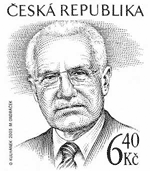
Below is the text of a speech which President Vaclav Klaus of the Czech Republic gave last Sunday in Aix-en Provence (France). We thank President Klaus for his kind permission to republish his speech at this website.
Thank you for the invitation to come to Aix, for giving me a chance to address this reputable audience where I see many friends and, above all, thank you for continuing to organize the Summer University. I only don’t understand why you call it Summer University of the New Economics. Which one is the old one? We have only one, good, old economic theory and it is our adversaries who use the term “new economics” as an attack on our views.
From the desk of Thomas Landen on Fri, 2009-08-28 06:54
It is hot in Brussels. Ramadan has begun. The faithful in the predominantly Muslim borough of Molenbeek are not allowed to eat or drink from sunrise until sunset. Non-Muslim policemen, patrolling the streets of Molenbeek in their sweltering cars, are not allowed to eat or drink either. As every year during Ramadan, they have been told by their superior, Philippe Moureaux, the Socialist mayor of Molenbeek, that they have to respect Muslim sensitivities and not to “provoke” Muslims by violating Islamic Ramadan restrictions in public. In effect, Islamic or Sharia law is already applied – for everyone – in the Muslim areas of Brussels.
