
Not in the Paper

A quote from Paddy McGarvey on David Rennie’s [the Brussels correspondent of The Daily Telegraph] blog, 9 September 2006

I fail to understand why David Rennie’s stories on the divisions within Belgium are not in the main paper. I believe Belgium is coming apart at the seams because of the ludicrous D’Hondt rules [a method for allocating seats in party-list proportional representation] making multi-party coalitions in the central government unworkable, so that to avoid the kind of situation that D’Hondt has caused in Northern Ireland, ergo no parliament at all, the government pushes dissent and dissenters downward and outward. The former country of two halves now has nearly a dozen regional parliaments or community councils, and poses a serious threat to the stability of the European Union, not to mention the other giant tenants in Brussels, the EU parliament and NATO.
Ghost Writer

A quote from the leftist philosopher and economist Prof. Philippe Van Parys in Brussel Nieuws, 9 September 2006

Belgium has a very bad image. I happen to know the publisher [editor?] of The Time Almanac, which includes a new chapter on Belgium. In the original text Belgium stood for corruption, pedophilia and the rows between the communities. All these ingredients were mixed in a short, unbalanced text, which, fortunately, I was able to refine. Recently The Wall Street Journal headlined: “The Many Faces of Belgian Fascism.” This was not a text about the Vlaams Belang (VB), but about the Belgian bureaucracy and the Parti Socialiste. Apparently, this journalist derived his inspiration from Paul Belien (the husband of VB parliamentarian Alexandra Colen). Obviously, this type of articles severely damage the reputation of our country.

What Happened to Global Warming?

Last Year Hurricane Katrina wrecked New Orleans. At the time the German government hinted that the hurricane had been caused by global warming, hence the American government was to blame for the catastrophe. This year the hurricane season was very mild. The US government must have done something good. Perhaps, with Iran building atomic boms, it is time to worry about nuclear winter again – unless Israel saves the climate...

Mapping the New Europe

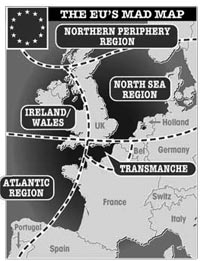
eureg-map.jpg

Ever since the Germans started using their word Lebensraum in connection with their policy towards Eastern Europe before the Second World War, one has to be suspicious when the word “Raum” is used in any policy connection by the Germans. For instance, Raumordnung can mean “spatial planning” if you want it to sound innocent and “area order” if you don’t. “Raum” can also mean territory. A “Raum” can also mean something as small as a habitat (as in the biological sense of “Lebensraum”), but the Germans have the same word as the British for region, and a “Raum” can also be something bigger than a region (which has its political expression in the German Länder.

But when Germans start to use the idea of “the European Area Development Concept” which includes chunks of the United Kingdom, one has to get really jumpy. This could also be translated as “European Spatial Development Concept” which, if anything would be worse.

Even Up There: Muslims Want Mosque in Reykjavík

The situation concerning immigration is a total disaster in Norway, Denmark and Sweden while things are somewhat better in Finland. This we all know. But what about the fifth Nordic country? Many foreigners see Iceland as a place where immigration is not a problem. Unfortunately, this is not the reality. Iceland is moving in the same direction as other western countries. The flow of immigrants, legal and illegal, asylum seekers and foreign workers to Iceland has been growing fast. Icelanders are victims of the same political correctness that brands everybody as “racist” and “xenophobe” who dares to question multiculturalism. Even those who merely call for an open and informed debate on the issue have been stigmatised.

Politicians Should Care about their Voters’ Health

A recent survey from IAPO (the International Alliance of Patients’ Organizations) clearly states that patients want the right to better healthcare information. IAPO is the global alliance representing patients of all nationalities across all disease areas, and includes input from ten EU member states. The survey highlights the need for more patient-centered healthcare with timely access to the best treatments and information on treatment options. The implications of the study for Europe are clear. In 1992 the European Union passed a directive prohibiting pharmaceutical companies from advertising their products. This ban is an attempt to keep healthcare costs in Europe down by securing lower living standards and less informed patients.

Dutch Protestants Soon Fewer than Muslims

Holland was once a Protestant (Calvinist) nation. Those days are gone. A report published earlier this week by the Sociaal en Cultureel Planbureau (SCP), entitled “Godsdienstige verandering in Nederland” (Religious Changes in the Netherlands), states that secularization will continue until it stabilizes at around 70 to 75% of the population by 2020. In 15 years from now over two thirds of the Dutch will no longer belong to any church, while the only remaining religious groups of any significance will be Catholics (10%) and Muslims (8%). Protestants will constitute a tiny minority of 4%.

Why Israel Should Now Battle with Iran

On 3rd September, London’s Sunday Times speculated that Israel has been planning a war against Iran and Syria, following the recent bout of conflict with Hezbollah in Lebanon. The report made a serious and viable claim on Israeli military strategy: “The conflict with Hezbollah has led to a strategic rethink in Israel. A key conclusion is that too much attention has been paid to Palestinian militants in Gaza and the West Bank instead of the two biggest state sponsors of terrorism in the region, who pose a far greater danger to Israel’s existence, defence insider’s say.”

Charlemagne at the FT, on Sarkozy

“The big political event in Europe over the weekend was a speech given in Marseilles by Nicolas Sarkozy, France’s interior minister and the right’s standard-bearer for the French presidency in next year’s elections. [...] Le Monde thinks that Sarkozy’s speech marked a sharp move to the right, [...], heaping praise on the United States for its social mobility and entrepreneurial energy. Perhaps Sarkozy has noted that the French are actually more ambivalent about the United States than they sometimes pretend,” writes Gideon Rachman on his blog at The Financial Times.

Gideon joined the FT last July. He spent the past years in Brussels as the Brussels correspondent of The Economist, where he wrote the influential “Charlemagne” column, currently being continued by his successor. Before his spell in Brussels he was the Washington correspondent of The Economist. Gideon is an expert in American foreign policy as well as EU affairs.

Syndicate content