Islam on Campus: A Cartoonist Visits the Ivy League

islm_cartoon_7.jpg
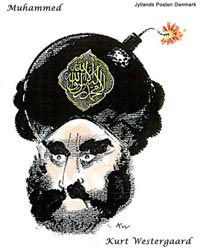
In early October, Kurt Westergaard, a Danish cartoonist, visited Princeton and Yale, two of America’s top universities, to speak to students, who are supposed to be tomorrow’s elite. The students did not feel any sympathy – indeed, were almost hostile – towards Mr. Westergaard, an artist who has been living under constant police protection since he drew a cartoon of Muhammad, the founder of Islam, four years ago.

Mr. Westergaard arrived at both Princeton and Yale heavily guarded by policemen. Ten officers kept watch inside the room – with more on guard outside – when he addressed his audience in Princeton. Such is life for Mr. Westergaard these days. “When, early in September 2005, I got a brief request from my editor to draw my impression of the prophet Muhammad, I had little idea of what I was getting myself into,” he told the students.


Ideology and Literature Revisited: Two Recent Novels about the Culture Wars by Gary Wolf

In earlier Brussels Journal contributions under the general rubric of “Ideology and Literature” I have made reference to Herman Melville, Nathaniel Hawthorne, Isak Dinesen, Jorge Luis Borges, and Ray Bradbury, among others. The West’s cultural crisis has deep roots; the awareness and analysis of that crisis also have deep roots. We tend to look to “experts,” rather than novelists and poets, to understand the prevailing condition. Perhaps the literary men would be better advisors. The corrosive doctrine called multiculturalism, for example, has an ancestry traceable to Jean-Jacques Rousseau’s proto-revolutionary rejection of modern European civilization and his notion of “the Noble Savage.” Herman Melville’s South-Sea novel Typee (1848) engages Rousseau keenly. Indirectly, as fiction typically does, but incisively, Typee suggests the gross inadequacy of Rousseau’s “rejectionist” argument and its accompanying “Noble Savage” theory. We may therefore say of Melville’s novel that, in addition to its fascination as a story, it has a cognitive function: in reading it we participate with Melville in careful consideration of the question, answered in the prejudicial affirmative by the author of The Social Contract, whether savagery is preferable to civilization. When Melville’s contemporary Nathaniel Hawthorne brings the psychological structure of fanaticism under scrutiny in The Blithedale Romance (1852), his narrative too is a deflationary analysis of socialism, which he regards as misplaced crusading religiosity.

Lisbon Treaty: Europe’s Slow-Moving Coup d’État

hellofrombarcelona.jpg

Irish voters have overwhelmingly approved the European Union’s controversial Lisbon Treaty, a document that will forever change the dynamics of European (and potentially global) politics. The “yes” vote comes less than 18 months after Irish voters gave the “wrong” answer by rejecting the treaty in a first referendum.

According to the final results, 67.1 percent of Irish voters approved the treaty, while 32.9 percent voted “no.” Turnout in the three-million electorate was 58 percent.

No Joke: Obama Wins Prize. Nobel Crashed

bj-logo-handlery.gif

Duly Noted. George Handlery about the week that was. The imperfections a functioning democracy do not prove the validity of extremist ideals. The left-right axis connects totalitarian extremes. A challenge to dragon-killers. Foreign conquest needs be followed by forced assimilation. Mass movements and the dictatorial trap. Aiming at Obama: do not use slingshots. The future’s bliss and the evils of the present.

1. Just before submitting this material and while clicking to re-check the final draft, the news appeared that BO has received the Nobel Peace Price. Stunned, I double checked the info. It is serious. For some time, and I was not alone, I had the impression that the value of the non-science prices have sunk. I now know that “sunk” is the wrong word. Replace “sunk” with “crashed”. No! the analogy is a U-Boat on a one-way mission. As in down “yes”, up, “no”. Even if I would be an BO fan, after only a few months in power, such a price would be disturbing. The more so, since BO had unfolded his tent in the Oval Office only recently. Not surprisingly, besides announced good intentions, there were, and there could be, no results. The conclusion: The Nobel committee votes, albeit a few months late, firmly Democratic. It will remain resolutely committed to this position until it becomes clear that the ruling Dem is, alas, on a part time-basis also an American.

Duly Noted: Fellow Travelers

bj-logo-handlery.gif

George Handlery about the week that was. The Polanski case: Some are against rape in principle and tolerant in practice. Save the economic order by suppressing the competition between states? Dictatorial centralization and great power status. National self-perception and its policies. Freedom, choice, insecurity and the age of ideology. About fellow-travelers.

It is hard to resist the temptation to bring up the Polanski arrest which is now everybody‘s favorite issue of distraction. Critics generally emphasize that the rape of a now forgiving minor has happened thirty years ago. The fact is true. However, such crimes have a way of surfacing well after the normal statute of limitations would run out. If the time for persecution would be limited then many transgressions could not be prosecuted. To be loudly against sexual (or human rights) abuse in principle, while in practice insisting that with the passing of time they should not be prosecuted, makes the first commitment sound comically hollow. The apologists like to forget that Polanski is a fugitive. Any statute of limitation for initiating persecution is irrelevant. Action has been taken in time but could not be completed since the accused, free on bail, has slipped away thereby preventing the conclusion of the case. Polanski is successful and talented.

Music and the Rise and Decline of Western Civilization

This text overlaps with a few of my earlier essays like Why Muslims Like Hitler, but Not Mozart. I have had some interesting discussions with Ohmyrus, the essayist who runs the Democracy Reform blog. He is a Chinese man who appreciates aspects of Western civilization that many Westerners have forgotten or rejected. He is not unique in this regard. One of the best books about European culture is Defending the West by the former Muslim Ibn Warraq, who was born in the Indian subcontinent. As a native European it is strange to notice how some (non-Muslim) Asians apparently appreciate my civilization more than intellectuals in my own country do. The Iranian-born ex-Muslim Ali Sina denounces Western Multiculturalism in his book Understanding Muhammad, which I have reviewed online:

“If any culture needs to be preserved, it is the Western, Helleno-Christian culture. It is this culture that is facing extinction….We owe our freedom and modern civilization to Western culture. It is this culture that is now under attack and needs protection.”

Europeans Ambivalent about Obama’s Retreat on Missile Defense

us-missile-defense.jpg
US President Barack Obama’s decision not to deploy a missile defense system in central Europe has received decidedly mixed reviews in Europe. Although newspapers and magazines across the continent have published editorials generally coming out in favor of Obama’s pronouncement, nearly all of them have also expressed deep skepticism that Obama’s so-called strategy of engagement with Russia will bear much fruit. 

Indeed, a consistent theme running through European commentary has been bafflement that Obama would abandon the missile defense system without receiving anything from Russia in return. A number of commentators have raised the issue of Obama’s lack of experience in statecraft. In Britain, for example, the Daily Telegraph published an editorial titled: “Barack Obama is Gambling with Europe’s Security.” Another article is titled: “President Barack Obama is beginning to look out of his depth.” It says: “His credibility is seeping away, and it will require concrete achievements rather than more soaring oratory to recover it.” 

On Friday Ireland Decides Europe’s Future

This Friday, the Irish people are again being asked to sign away their sovereignty and freedom to the European Union authorities in Brussels. When the matter was put before them in a referendum in 2008, the Irish voted “No.” Now they have been told to vote again on the same matter. Ireland is the only country of the 27 EU member states where the people are allowed a direct vote about their future. In the other 26 countries which together with Ireland make up the European Union, the governments – not the people – have already decided to transfer national sovereignty to Brussels.

A Brief History of Zero and Indian Numerals

I heard the claim from one European reader that “The Arab world invented the zero, and it’s been downhill ever since.” This is false, but unfortunately not an uncommon mistake. Our numeral system dates back to India during the post-Roman era, but it came to Europe via the medieval Middle East which is why these numbers are called “Arabic” numbers in many European languages. Yet even Muslims admit that they imported these numerals from India. Calling them “Arabic” numerals is this therefore deeply misleading. “Hindu-Arabic” number system could be accepted, but the preferred term should be “Indian numerals.”


“The Catastrophe” - Part 2: What the End of Bronze-Age Civilization means for Modern Times

 Introduction to Part II: In Part I of this essay, I began by reminding readers of the necessary complacency that accompanies civilized life. Civilized people go about their lives on the dual assumption of institutional permanency and a continuity of custom. The assumption that plans made today will see their fruition tomorrow belongs to the background of organized existence and contributes to motivating our purposive behavior. The same assumption can lapse into complacency, however, so that, even as signs of trouble emerge on the horizon, a certain denial disarms people from responding to looming disruption with sufficient swiftness and clarity. People take civilization for granted; they rarely contemplate that it might come tumbling down about their ears. Insofar as the historical record has something important to teach ordinary people who are not specialists in the subject, it might well be the lesson that all known societies before the modern society have come to an end. Some of them have come to an end abruptly and violently.

Syndicate content