Anti-Semitism Sweeps Europe in Wake of Gaza Operation

eu-israel-small.jpg

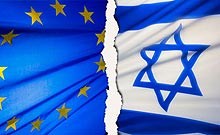
A second front to the conflict in the Gaza Strip has opened up in Europe, where a wave of reprisal attacks against Jewish targets is stoking fears of a wider resurgence of anti-Semitism on the continent. Far from simply being a spate of isolated incidents, as many Europeans claim, anti-Semitic violence is becoming more commonplace in every country in Europe. At the same time, anti-Israel demonstrations, which have strong anti-Semitic overtones, are being held with alarming frequency in cities across Europe.

Is Putin the Greens’ poster boy

The cheery chappies over at the Competitive Enterprise Institute have noticed an interesting thing about Putin’s gas shenanigans with Ukraine. He is of course helping drive down the usage of energy in Europe, a goal so beloved of the green wallas.

Chevron have been running a campaign wearing their Corporate Social Responsibility hat, called ‘I Will Use Less Energy’.

I will use less energy. And we will too.
The world demands more and more energy. Where will it come from?
We at Chevron are working to provide more of it, both responsibly and efficiently. And we’re developing alternatives.
But it’s just as important for all of us to do more with less.

So should Putin be Chevron’s poster boy?


Naming Things by their Right Names

The gnomic philosopher and father of the “Logos” tradition, Heraclitus of Ephesus, says in what scholarship usually arranges to be the first of his surviving fragments that the man of wisdom has a dual duty to discern the essence of every significant thing and to name it properly. A necessary element of any intellectual doctrine incorporating an idea of truth as something linked to an actually existing external world, this venerable fifth-century BC philosophical notion also supplies scientific investigation with one of its primary goals. In Plato’s dialogues, Socrates, who speaks admiringly of Heraclitus and often quotes him, shows a penchant, when in conversation with his sophistic partners, to wheedle them about proper definitions of terms. Skeptical readers of Plato’s text and the non-metaphysically inclined find in this trait no little annoyance. But even skeptics and the non-metaphysical need, on occasion, to define who they are. In one of the ironic features of the Platonic text, Socrates not infrequently fails to arrive at the proper or convincing definition of a term. The most notorious such failure comes with the case of “the Good,” a topic in most of the dialogues. But the principle is here the important thing, not its fulfillment in every instance. It might well be that defining terms can pose difficulties, especially in the case of the most important, most unavoidable concepts, such as “the Good.”

Duly Noted: Disproportional Outrage

bj-logo-handlery.gif

George Handlery about the week that was. Radicalizing the radicals. Will “Gaza” strengthen the moderates? Proportional warfare or disproportional outrage? We are responsible for the actions of those who are able to govern us. If you cannot win a war resort to diplomacy. The Dictator’s Tantrum #6.
 
1. This week’s Duly Noted’s content has been shaped by the salient events of the Near East. There is a justification. The reaction to, and the handling of the conflict predicts the way we will cope with the tension accumulating between modern societies and Islamism.

Playing to Win in Gaza

As the Israeli attack on the Gaza Strip nears the end of its second week, two things are clear: first, that it will come to some sort of internationally brokered end; and second, that it will end thus because there is no other end that Israel will countenance. This is not to say that there is no other end Israel wants, but it cannot have what it wants — Hamas will neither be destroyed nor neutered — and so the question of the end is a question of what it may have. For all the vitriol the Jewish state receives every time it attacks those who attack it — be it a Vatican hierarch invoking the Holocaust(!), or the United Nations harrumphing about the sanctity of its property — the ground truth is that Israel lacks the bloody-mindedness to end things as it might, and as its enemies certainly would.

The West’s Cultural Continuity: Aristotle at Mont Saint-Michel

 
Sylvain Gouguenheim’s "Aristote au Mont Saint-Michel: Les racines grecques de l’Europe Chrétienne" reviewed by Thomas F. Bertonneau

Long before the late Eduard Said invented “Orientalism” to exalt Arab culture and Islamic society at the expense of the West, bien-pensants like Voltaire inclined to express their rebellion against the dwindling vestiges of Christendom by representing Europeans as bigots or clowns and raising up exotic foreigners – Voltaire himself wrote about Turks and Persians of the Muslim fold – to be the fonts of wisdom and models of refined life in their tracts and stories. The sultan and dervish look with amused tolerance on the gaucheries of the European rubes. The rubes swing their elbows and knock over the pottery. It was the Eighteenth-Century philosophes and illuminati who coined the pejorative term Dark Ages to refer to the centuries immediately following the collapse of the Roman imperial administration in the West under pressure of the Gothic assertions of the Fifth Century. Liberal discourse often casually extends the same term to apply it to all of medieval European civilization up to the Renaissance. Specialist historians have, however, long since demonstrated that no such absolute discontinuity as the term Dark Ages insinuates ever existed, which means that the Enlightenment version of history is at least partly wrong. And yet the usual story retains its currency, as an item in a kind of liberal folklore.

Demonstrations in Paris: Some Lead to Vandalism, Others Do Not

Demonstrations that make the car burnings of New Year's Eve look like a school picnic have been taking place all over France.

According to Le Parisien, 21,000 persons demonstrated in Paris against the Israeli offensive in Gaza. A few hundred attempted to get into the Israeli Embassy but were stopped by police barricades around Place Saint-Augustin and Boulevard Haussmann. Many were wearing a kaffyeh and chanted slogans such as "We are all Palestinians, Israel: Assassin". "Gaza, Gaza, we are with you".

Duly Noted: Hamas Does Not Respond to Criticism

bj-logo-handlery.gif

George Handlery about the week that was. The choice of facts determines the case. Can the Palestinians deliver on their contract? The uses of “distributory foreign policy”. Piracy is a low-risk enterprise. Bank robbers are around: liquidate the banks.
 
1. This is how CNN International commented (Dec. 27) the IDF’s action in Gaza: Israel attacked “just a week after the cease-fire ended”. This rendition is constructed upon two connected occurrences. Event A is the expiration of the cease-fire. Event B is the action against Hamas. If we only concentrate on these two components, we get the impression of a rather rash action taken in response to a development in which both sides might share responsibility. (Without pockets, there would be no pickpockets.) Thereby the case is made for the “overreaction” as some commenting governments label the sorties. Only the chain of events has a third component. It is the rocketing of Israeli settlements (call them indiscriminate attacks) by Hamas in control of Gaza, the area from which the action originates. In this case the chain of events ranges from an expired cease fire, then it proceeds through rocket attacks on civilians that are guilty of being Jews and finally the process is completed by the IDF’s attempt to bomb Hamas targets. Through the insertion of the additional component, the two cases become highly dissimilar. Therefore, so must be their evaluation. Anyone who, while aware of the second scenario sticks knowingly to the first one becomes guilty of distortion by suppressing a salient fact. It is not right that this happens but it is, at the same time, hardly surprising.

Syndicate content